
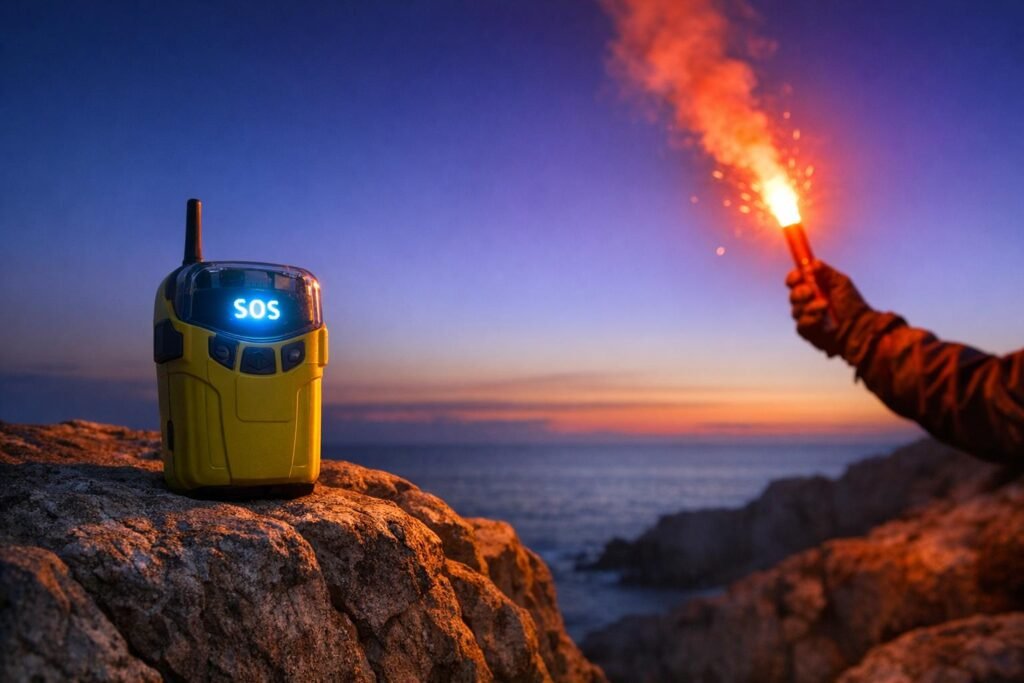
When you’re in a survival situation, two tools stand out: emergency beacons and signal flares. Here’s the key takeaway: beacons alert rescuers to your location via satellite, while flares help them find you once they’re nearby. Both have unique strengths and limitations, and understanding these can save your life.
Quick Overview:
- Emergency Beacons: Use satellites to send GPS coordinates. Reliable anywhere, regardless of weather or cell service. Ideal for remote areas.
- Signal Flares: Provide a visual signal. Best for close-range visibility when rescuers are nearby.
Quick Comparison:
| Tool | Purpose | Range | Cost | Lifespan |
|---|---|---|---|---|
| PLBs | Long-range GPS distress | Global | ~$300–$500 | 5–10 years |
| Pyrotechnic Flares | Short-range visual signal | Up to 25 miles | ~$40 (3-pack) | 3–4 years |
| LED Flares | Nighttime visual signal | Several miles | ~$80–$200 | Indefinite (battery) |
Pro Tip: Use both for maximum safety – beacons to call for help and flares to guide rescuers in close range. Keep reading for a breakdown of how each works and when to use them.
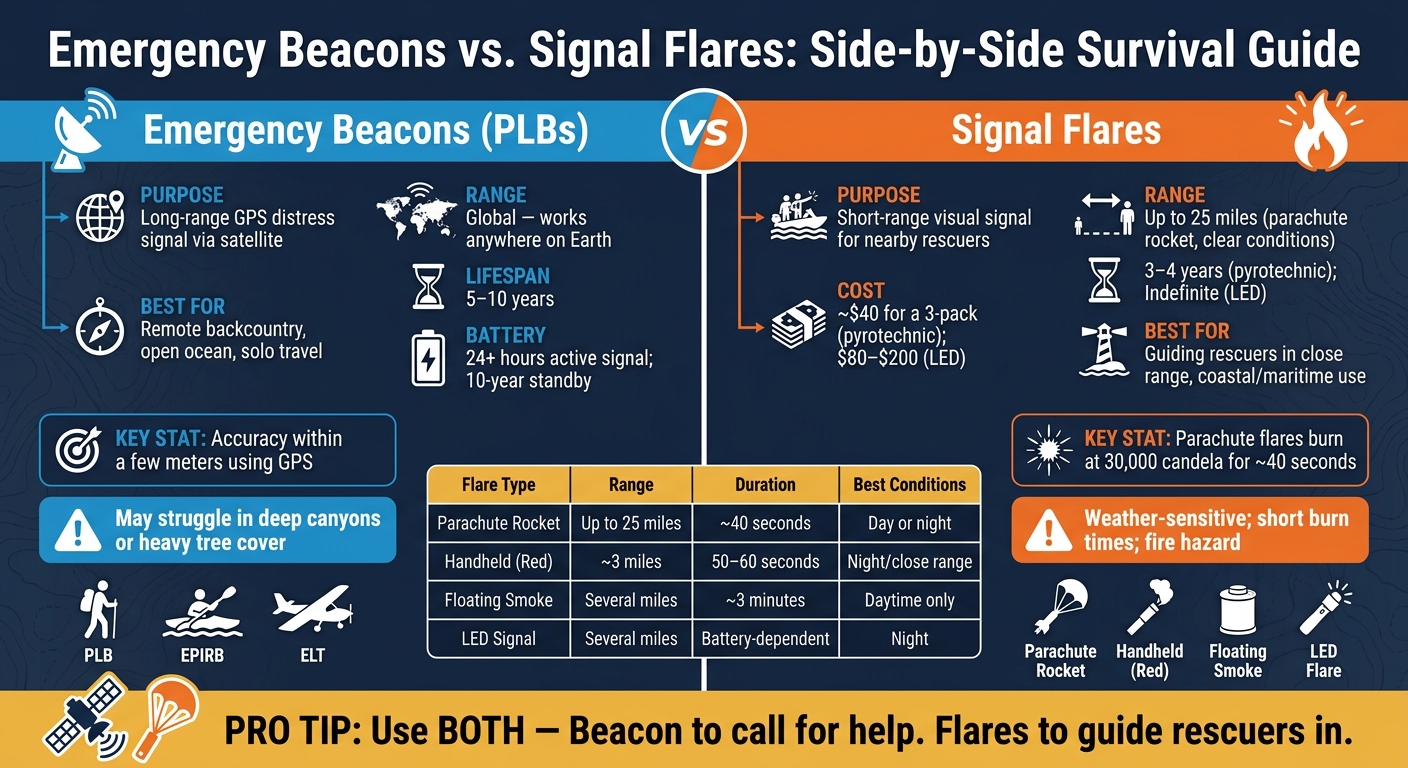
Emergency Beacons vs. Signal Flares: Side-by-Side Survival Guide
Distress Signals: Pyrotechnics v PLB (Personal Location Beacon)
sbb-itb-5a98267
How Emergency Beacons Work
When you activate an emergency beacon, it sends out a distress signal on 406 MHz, a frequency exclusively reserved for search and rescue operations. This signal is picked up by the COSPAS-SARSAT satellite network and relayed to ground stations and rescue coordination centers. The system ensures that your call for help reaches search and rescue teams quickly and efficiently.
Modern beacons equipped with GPS can pinpoint your location within a few meters, embedding these coordinates directly into the distress signal. In contrast, older models rely on multiple satellite passes to triangulate your position, which can delay rescue efforts. This high level of accuracy makes GPS-enabled beacons a must-have for serious outdoor adventurers.
There are three primary types of 406 MHz beacons, each designed for specific environments:
- PLBs (Personal Locator Beacons): Compact and handheld, ideal for hikers, hunters, and paddlers.
- EPIRBs (Emergency Position-Indicating Radio Beacons): Larger devices made for maritime use, often with automatic activation when submerged.
- ELTs (Emergency Locator Transmitters): Installed in aircraft and designed to activate upon impact.
Once rescuers are nearby, most beacons switch to a secondary frequency, 121.5 MHz, allowing search teams to home in on your exact location using specialized equipment.
While SENDs (Satellite Emergency Notification Devices) like Garmin inReach or SPOT offer two-way messaging, they rely on commercial networks like Iridium or Globalstar. This dependency often results in weaker signals compared to dedicated 406 MHz beacons.
Understanding how these devices operate highlights their strengths and limitations in emergency scenarios.
Strengths of Emergency Beacons
The standout feature of emergency beacons is their ability to function anywhere on Earth, regardless of cell coverage, weather, or time of day. Whether you’re stranded in the Boundary Waters Canoe Area Wilderness in Minnesota or capsized off Alaska’s coast, the satellite network ensures your distress signal gets through.
PLBs are also built for durability. Many models boast standby battery lives of up to 10 years, and once activated, they provide at least 24 hours of continuous signal transmission. Devices like the Ocean Signal rescueME PLB1 are particularly appealing because they don’t require monthly or annual subscription fees, making them a cost-effective choice for long-term outdoor safety.
Limitations of Emergency Beacons
Despite their reliability, emergency beacons have limitations. Satellite visibility is a key challenge. If you’re in a narrow canyon in Utah or under heavy tree cover in the Pacific Northwest, the signal may struggle to reach satellites. For optimal performance, activate the beacon in an open area with the antenna positioned vertically.
Cost is another factor. High-quality PLBs or EPIRBs typically cost between $300 and $500. SENDs add recurring subscription fees to that initial expense. Additionally, registration is legally required in the U.S. All 406 MHz beacon owners must register their devices with NOAA and renew the registration every two years. Skipping this step not only risks fines but also delays rescue efforts, as registration data helps SAR teams identify the person in distress and contact their emergency contacts.
How Signal Flares Work
Signal flares are essential tools for signaling distress, designed to grab attention through bright light, fire, or colored smoke. Unlike emergency beacons that rely on satellites, flares work by creating an immediate visual signal. This makes them a critical choice in situations where quick, visible recognition is necessary.
There are four primary types of signal flares, each suited to specific scenarios:
- Parachute rocket flares: These launch up to about 1,000 feet, deploy a parachute to slow their descent, and burn at 30,000 candela for roughly 40 seconds. In clear conditions, they can be seen from up to 25 miles away.
- Handheld flares: Designed for close-range use, they burn at 15,000 candela for 50–60 seconds and are visible up to about 3 miles. These are especially helpful for pinpointing your location to nearby rescuers.
- Floating smoke signals: These release dense orange smoke for approximately 3 minutes, making them highly effective during the day for attracting attention from helicopters or low-flying aircraft.
- LED distress signals: Powered by batteries, these non-pyrotechnic devices flash white light 50–70 times per minute and are reusable. They are ideal for nighttime use.
Here’s a quick comparison of these flare types:
| Flare Type | Visibility Range | Duration | Best Conditions |
|---|---|---|---|
| Parachute Rocket | Up to 25 miles | ~40 seconds | Day or night |
| Handheld (Red) | ~3 miles | 50–60 seconds | Night or close range |
| Floating Smoke | Several miles | ~3 minutes | Daytime only |
| LED Signal | Several miles | Battery-dependent | Night |
Pro Tip: Fire parachute flares a few minutes apart instead of all at once. This creates two distinct reference points, helping rescuers triangulate your position. Also, aim flares about 15° off vertical and downwind to avoid falling debris.
Strengths of Signal Flares
Signal flares shine in scenarios where immediate, visible confirmation is critical. While emergency beacons initiate the rescue process, flares ensure rescuers can locate you quickly, especially in close-range situations. For example, holding a red handheld flare over the water side of a vessel can guide a rescue boat directly to you in seconds. Similarly, smoke signals are highly visible to aerial rescuers during the day, while LED flares offer a safe, reusable option for nighttime emergencies.
Limitations of Signal Flares
Despite their advantages, flares come with notable drawbacks. Their burn times are short – most pyrotechnic flares last only 40 to 60 seconds. Additionally, the intense heat they produce (up to 2,910°F) poses a fire hazard, with molten slag capable of causing burns or igniting nearby materials.
"Pyrotechnic devices generate intense heat and dripping slag, which can cause burns or ignite flammable materials." – America’s Boating Club
Storage and maintenance can also be challenging. Flares need to stay dry and accessible, and they have a limited shelf life – typically expiring 4 years after manufacture. Using expired flares is risky, as they may fail when needed most. Proper disposal is also required; expired flares must be taken to hazardous waste sites or marina collection points. Lastly, firing a distress flare without a genuine emergency is illegal, as it diverts resources from those in real need.
Emergency Beacons vs. Signal Flares: A Direct Comparison
Emergency beacons and signal flares serve different roles in rescue situations but complement each other to enhance your chances of being found. While emergency beacons transmit your GPS location via satellite to initiate a rescue, signal flares provide a visual guide for rescuers once they’re nearby. Let’s dive into how these tools perform under various conditions and what they cost.
Use Cases by Activity
Choosing the right tool depends on your activity. For remote backpacking or hiking, a Personal Locator Beacon (PLB) is essential because it works without relying on cell signals. On the water, such as during boating or kayaking, both tools shine in their own ways. A PLB can alert rescuers to your location, while a handheld flare or smoke signal helps pinpoint you for nearby Coast Guard vessels or helicopters.
For kayakers, electronic LED flares are a safer alternative to traditional flares. Their non-combustible design makes them ideal for use in tight spaces, like a kayak cockpit, where safety is a priority.
Performance in Different Conditions
PLBs are incredibly dependable in bad weather. They transmit on the 406 MHz frequency via the COSPAS-SARSAT satellite network, ensuring that fog, rain, or snow won’t impact their performance. In contrast, flares can be hit or miss depending on the conditions. For example, a parachute rocket flare can be seen up to 28 miles away in clear weather but loses effectiveness in poor visibility.
Smoke signals are even more weather-sensitive. In strong winds, the visibility of an orange smoke signal can drop from about 2.5 miles to just 0.6 miles as the smoke disperses. At night, LED electronic flares stand out with up to 60 hours of continuous flashing, far surpassing the brief burn time of traditional pyrotechnic flares. However, standard white LED flares may not be visible to rescuers using infrared night-vision goggles. Devices that meet the RTCM standard, which include an infrared (IR) light component, are a better choice.
"The LED lights cannot be seen by the InfraRed night vision goggles worn by USCG pilots and copilots." – Bruce Brown, Safety Officer
Cost and Upkeep
Cost and maintenance are key factors when choosing between these tools. Pyrotechnic flares are affordable upfront, costing around $40 for a three-pack, but they expire every 3–4 years and require proper disposal due to their hazardous nature.
| Tool | Upfront Cost | Recurring Cost | Lifespan |
|---|---|---|---|
| PLB (e.g., ACR ResQLink 400) | ~$360 | Battery swap every 5–10 years | 5–10 years |
| Electronic LED Flare (e.g., ACR ResQFlare) | ~$80–$200 | Periodic battery replacement | Indefinite |
| Pyrotechnic Flares (3-pack) | ~$40 | Replace every 3–4 years | 3–4 years |
PLBs, like the ACR ResQLink 400 ($359.95) or McMurdo FastFind 220 ($249.95), come with a higher initial cost but no recurring subscription fees. They only require a battery replacement every 5–10 years. For long-term adventurers, PLBs are a dependable investment. Meanwhile, electronic flares offer a cost-effective, one-time purchase solution that’s easy to maintain.
How to Pick the Right Tool for Your Trip
When planning your trip, the remoteness of your destination is the most critical factor to consider. If you’re venturing into areas without cell service – whether that’s deep in the backcountry, out on open water, or in a wilderness far from any trailhead – a personal locator beacon (PLB) becomes a must-have. PLBs use satellite technology to alert global rescue centers, even in the most isolated locations. On the other hand, traditional signal flares only work effectively when rescuers are within about 7 miles of your position.
Your personal circumstances also play a role in choosing the right tool. For solo travelers, carrying a PLB is non-negotiable since it’s the only reliable way to call for help in an emergency. In group settings, having at least one PLB ensures someone can summon assistance if needed.
If you’re traveling in fire-prone areas, such as the American West during summer, traditional pyrotechnic flares can be risky. Instead, opt for LED electronic flares. These provide a safer alternative, with no combustion risk and up to six hours of battery life. Brenan Greene, Founder of Trail4R.com, emphasizes this point: "I would only use the traditional flares if needed in the winter or when the ground is moist. We already have enough California Wildfires."
For maximum safety, combining both tools is the ideal approach. A PLB allows rescuers to locate you quickly via GPS, while flares – whether LED or traditional – can visually guide them once they’re nearby.
"Distress flares… should be used as back-up options to PLBs as they typically do not come with the same geolocation satellite technology. They are, however, a highly effective tool for alerting incoming rescue teams." – Guy Arnold, OSAT
Conclusion
Emergency beacons and signal flares work best together. Personal Locator Beacons (PLBs) take care of long-range communication, sending your GPS location through the COSPAS-SARSAT satellite network to rescue centers across the globe. Signal flares, on the other hand, are for close-range visibility, helping rescuers pinpoint your location once they’re en route.
Neither tool is enough on its own – beacons alert rescuers, while flares help guide them to you.
As one expert puts it:
"Integrating locator beacons and flares into our safety toolkit is a small yet impactful step towards ensuring that our exploration of the great outdoors remains a source of joy and excitement, rather than a tale of survival."
In short: rely on a beacon to call for help and flares to lead rescuers in. At Adventurism.co, we advocate for the smart preparation of combining these tools to stay safe while enjoying the outdoors.
FAQs
Do I need a PLB if I already have a satellite messenger?
If you already own a satellite messenger, you might not need a PLB – but it really comes down to your specific safety requirements. Satellite messengers allow for two-way communication, which is great for non-emergency updates or staying in touch. On the other hand, PLBs are strictly designed for emergency SOS alerts, using the highly dependable COSPAS-SARSAT network. One key advantage of PLBs is that they don’t require a subscription, making them a reliable and cost-effective option, especially as a backup or primary tool in remote areas where signaling for help is vital.
Will an emergency beacon work in dense trees or narrow canyons?
Emergency beacons are designed to function in tough environments like dense forests or narrow canyons. However, obstacles such as thick foliage or canyon walls can interfere with their performance. These devices depend on satellite networks, and in areas with heavy obstructions, signal transmission might face delays or reduced range. While they’re built for challenging conditions, it’s important to be aware that natural barriers can still impact their effectiveness.
What’s the safest flare option in fire-prone areas?
LED or electronic flares are the go-to choice for fire-prone areas. Unlike traditional pyrotechnic flares that rely on open flames and generate intense heat, LED flares provide a safer alternative. They emit light without producing sparks or flames, significantly lowering the risk of starting a fire. This makes them an excellent option for signaling during emergencies in dry or wildfire-prone regions.