
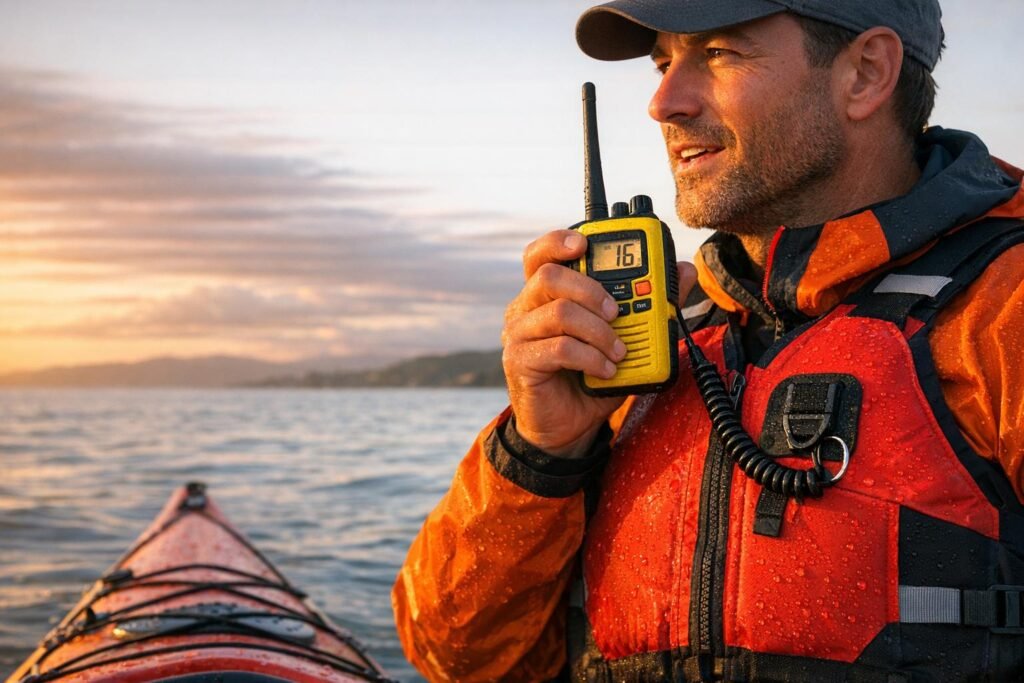
VHF radios are a must-have for kayakers. They provide reliable communication on the water, especially in emergencies, where cell phones often fail. Unlike phones, VHF radios broadcast to all nearby vessels and the Coast Guard, ensuring your distress signal is heard. These radios also offer NOAA weather updates and group communication options.
Here’s what you need to know:
- Why VHF Radios? They work without cell towers, allow two-way communication, and help rescuers locate you using direction-finding technology.
- Key Features: Waterproof, floating design, long battery life, NOAA alerts, and Digital Selective Calling (DSC) with GPS for fast distress signaling.
- Emergency Use: Learn the correct protocols for Mayday, Pan-Pan, and Sécurité calls. Always monitor Channel 16 for emergencies.
- Best Models: Popular options include Icom IC-M24 (budget-friendly) and Standard Horizon HX850s (built-in GPS and DSC).
- Safety Setup: Pair your radio with a PFD, tether, flares, and a Personal Locator Beacon (PLB) for a complete safety system.
VHF radios are your lifeline on the water. Always keep it accessible, fully charged, and ready to use.
Choosing the Right VHF Radio for Kayaking
Key Features to Look For
When it comes to kayaking, not all VHF radios are created equal. Some features are absolutely essential for safety and convenience. Waterproofing and floatability should top your list. Radios with an IPX7 or IPX8 rating can handle full submersion, not just light splashes. Many models also float and activate a flashing strobe light when dropped in water, making them much easier to retrieve after a capsize.
Another critical feature is Digital Selective Calling (DSC) paired with a built-in GPS. With just one press of the distress button, your radio can transmit your exact location to the Coast Guard and nearby vessels. This is especially crucial for solo paddlers, where quick communication can make all the difference. Additionally, NOAA weather alerts allow you to monitor changes in weather conditions in real time, eliminating the need for an extra device.
Don’t overlook practical considerations like battery life and button design. Most handheld VHF radios provide 13 to 15 hours of battery life, though frequent high-power transmissions can reduce this. Starting your trip with a fully charged battery is a must. Also, since kayakers often wear gloves, look for radios with large, tactile buttons that are easy to operate. Once you’ve identified these features, it’s time to explore some popular models.
Popular VHF Radio Models for Kayakers
Here’s a quick look at some VHF radios that combine essential features for different kayaking scenarios:
| Model | Key Strengths | Best For |
|---|---|---|
| Icom IC-M24 | Floats, flashing light when submerged | Budget-conscious paddlers |
| Icom IC-M72 | Waterproof, large glove-friendly buttons | Everyday coastal use |
| Standard Horizon HX300 | Floats, USB charging (~$130) | Multi-day trips |
| Standard Horizon HX751 | Floating handheld, reliable build | Intermediate paddlers |
| Standard Horizon HX850s | Integrated GPS, advanced DSC | Offshore or solo paddling |
The Standard Horizon HX300 is a favorite for its USB charging capability, which allows you to recharge it from a car, laptop, or portable power bank. At around $130, it’s a solid mid-range option. For those prioritizing built-in GPS and DSC, the HX850s is a standout choice. It eliminates the need for extra devices, making it ideal for offshore or solo adventures. Plus, Standard Horizon offers a 3-year warranty that covers water damage, giving you peace of mind for a device that’s bound to get wet.
How to Secure and Protect Your Radio
Even the best radio won’t help if it’s not accessible when you need it. Proper mounting and care are just as important as choosing the right model.
"In choosing how to carry your radio, you need to assume that you would not need it unless you were in difficult conditions, potentially swimming and possibly even without your boat." – Brian Nystrom, Kayaking Instructor
This advice highlights the importance of keeping your radio on your body, not stashed away in your kayak. A waterproof VHF radio mounted on your PFD (personal flotation device) – either in a dedicated pocket or attached to a shoulder strap – ensures you can grab it quickly, even in rough conditions. If you choose a shoulder mount, secure the radio with a small bungee loop to prevent it from flipping upside down or falling during a roll.
Always use a tether to attach the radio to your PFD. A short leash keeps it secure without risking entanglement. After each saltwater outing, rinse your radio with fresh water to remove salt and prevent damage. Applying dielectric grease to the charging terminals can also help slow corrosion and extend the life of your device.
sbb-itb-5a98267
Setting Up and Using Your VHF Radio
Licensing and Channel Basics
In the U.S., paddlers don’t need a license for domestic VHF radio use. However, if you’re traveling internationally or your vessel has an HF single sideband radio, a license is required. In Canada, the rules are stricter – paddlers must take a short course and obtain a license before operating a VHF radio.
Understanding the basics of VHF channels is key to safe and effective communication. Channel 16 is the cornerstone of marine communication, serving as the international distress and hailing frequency. It’s monitored by the U.S. Coast Guard and nearly every vessel on the water.
"Channel 16 is known as a hailing frequency and is used to establish contact between vessels before you move your conversation to another channel." – Bryan Hansel, Author and Paddling Expert
Federal regulations mandate that you monitor Channel 16 or Channel 9 whenever your radio is on and you’re not actively using it. For general group communication, stick to designated non-commercial channels. Here’s a quick guide:
| Channel | Primary Use |
|---|---|
| 16 | Distress, emergencies, and initial hailing |
| 9 | Secondary hailing (popular in the Northeast U.S.) |
| 22A | U.S. Coast Guard safety broadcasts |
| 68, 69, 71, 72 | Recreational group communication |
| 70 | DSC distress alerts only – voice not permitted |
| WX1–WX7 | NOAA weather updates |
Before heading out, it’s essential to ensure your radio is working properly through a few simple checks.
Pre-Launch Checks
A faulty radio can be just as dangerous as not having one at all. After setting your channel, follow these steps to confirm your radio is ready to go:
- Charge the battery fully: High-power usage drains batteries quickly, and research shows nearly half of radios fail within a year if not properly maintained.
- Set squelch and test reception: Adjust the squelch until static is audible, then dial it back until the noise disappears. After charging, test both transmission and reception by tuning into a local NOAA channel.
- Avoid testing on Channel 16: Using Channel 16 for tests risks sending false distress signals. The U.S. Coast Guard treats hoax calls as a Class D felony, carrying fines up to $5,000 plus response costs.
- Check your power setting: Use 1W for short-range communication within your group. For distress calls, switch to 5W or 6W to extend your range.
Using VHF for Day-to-Day Communication
For routine group communication on the water, stick to channels like 68, 69, 71, or 72. Start by hailing on Channel 16 or 9, then agree on a working channel to continue the conversation. This ensures the hailing channels remain open for emergencies.
When transmitting, always listen first to confirm the channel is clear. Press the PTT (push-to-talk) button, pause for a second, and then speak. This brief pause ensures your first word isn’t cut off. Keep your messages short and to the point – only one person can talk on a channel at a time. Use "Over" to indicate you’re waiting for a response and "Out" when the conversation is finished.
To stay updated on weather conditions, tune into your nearest WX channel before setting out and check periodically during your trip. If the Coast Guard issues a broadcast, they’ll announce it on Channel 16 and direct you to Channel 22A for the full message. Familiarizing yourself with this process ensures you won’t miss critical updates while on the water.
How to Call the Coast Guard on your Sea Kayaker’s Marine VHF Radio | Adventure Kayak | Rapid Media
Emergency Procedures and Rescues
How to Make a VHF Mayday Call: Step-by-Step Guide for Kayakers
When to Call for Help
It’s essential to call for help at the first signs of trouble – whether it’s an injury, hypothermia, a capsized kayak, or worsening weather conditions. If someone in your group is hurt, showing signs of hypothermia, or if a kayak is taking on water and becoming unmanageable, reach out immediately. Similarly, if the weather takes a turn for the worse and you can no longer paddle safely, it’s time to get assistance. Don’t wait until the situation becomes critical. Making a Pan-Pan call for an issue that’s urgent but not life-threatening – like an exhausted paddler – can keep things from escalating into a Mayday emergency.
"The VHF radio is only useful if there is someone there to hear your call." – Tom Pogson
Under good conditions, a VHF radio might reach a ship or coastal station within about 5 miles. But if you’re in a remote area with no nearby vessels, your opportunity to get help is limited. This makes it even more important to act early.
How to Make a Distress Call
Once you recognize the need for outside help, using the correct radio protocol is critical. There are three main types of radio calls for emergencies, each suited to a different level of urgency:
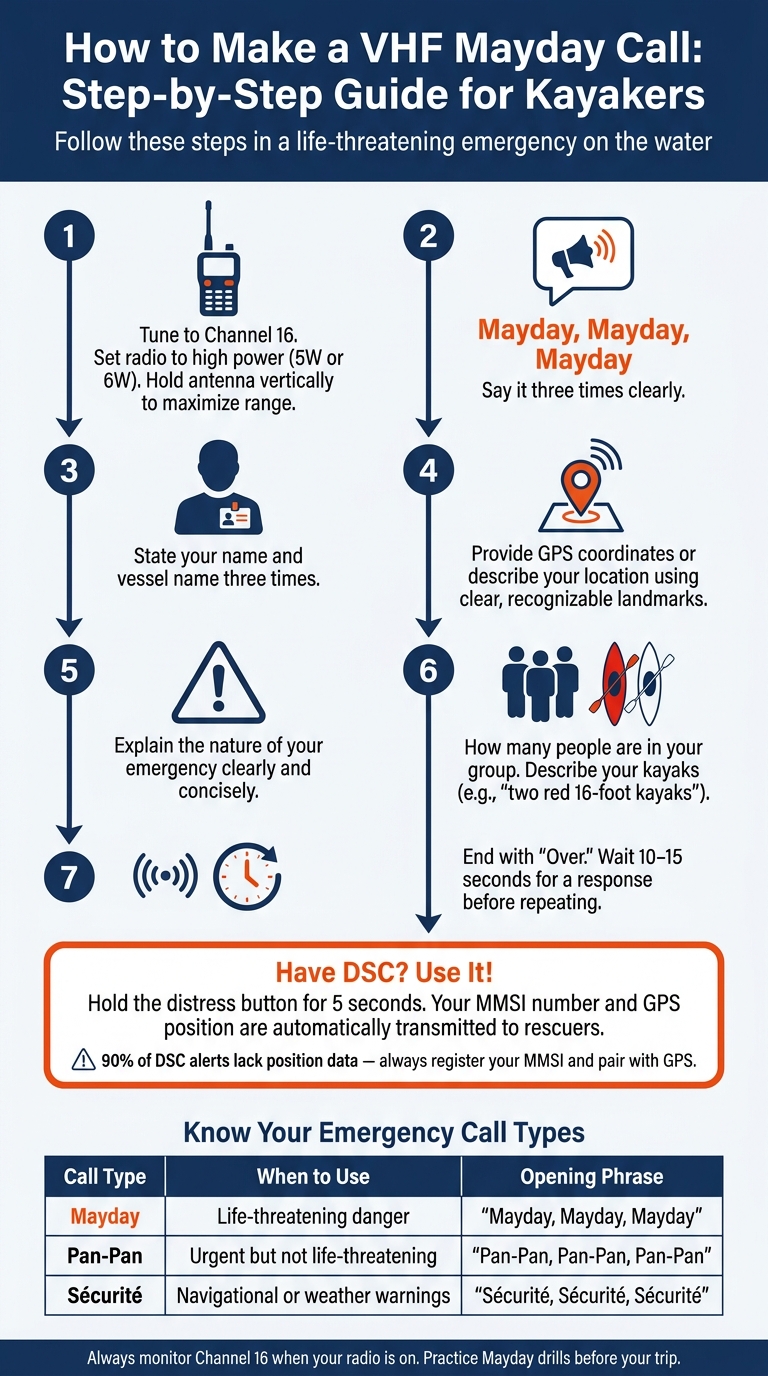
| Call Type | When to Use | Opening Phrase |
|---|---|---|
| Mayday | Life-threatening danger to life or vessel | "Mayday, Mayday, Mayday" |
| Pan-Pan | Urgent but not immediately life-threatening | "Pan-Pan, Pan-Pan, Pan-Pan" |
| Sécurité | Navigational or weather-related warnings | "Sécurité, Sécurité, Sécurité" |
For a Mayday call, switch to Channel 16, set your radio to high power, and hold the antenna vertically to maximize range. Follow this step-by-step process:
- Start by saying "Mayday" three times.
- Identify yourself and your vessel three times.
- Provide your GPS coordinates or describe your location using clear landmarks.
- Explain the nature of your emergency.
- State how many people are in your group.
- Describe your kayaks, such as "two red 16-foot kayaks."
- Conclude with "Over."
A real-life example of this occurred in February 2012, when kayaker Dave Olson made a Mayday call in the Apostle Islands on Lake Superior. His paddling partner was severely dehydrated and behaving delusionally. The U.S. Coast Guard responded, verified Olson’s location six times, and sent a rescue boat. They met the group near Basswood Island, provided IV fluids, and transported the individual to a hospital via the Red Cliff dock.
"The USCGS got there in a hurry but not before verifying my location at least six times. I think they may have had experience with people who had no clue about where they were." – Dave Olson, Kayaker
If your radio has Digital Selective Calling (DSC), hold the distress button for five seconds. This sends your registered MMSI and GPS position to responders, helping them locate you quickly. However, it’s worth noting that 90% of DSC distress alerts received by the U.S. Coast Guard lack position details, and 60% don’t include a registered identity. Registering your MMSI and pairing your radio with GPS ensures DSC is effective during an emergency.
If no one responds to your initial Mayday call, wait 10 to 15 seconds before repeating. This pause allows rescuers to reply without interference.
Working With Rescuers
Once you’ve made contact, clear communication with rescuers becomes your top priority. Stay on Channel 16 unless directed to switch to another channel. Follow all instructions carefully and speak slowly, clearly, and calmly – a steady tone cuts through radio static better than a rushed or panicked voice.
Be prepared to repeat your position multiple times. Rescuers often ask for this information more than once to confirm accuracy, especially in areas with few landmarks. Use GPS coordinates if available, or describe your location relative to a recognizable feature, such as a buoy, a harbor entrance, or a point of land.
If you’re part of a group, assign one person to handle all radio communication. This avoids confusion and keeps the process efficient. Leave the channel clear between transmissions so rescuers can respond promptly. These steps are crucial for maintaining clear and effective communication during emergencies, ensuring the best possible outcome for everyone involved.
Maintaining and Practicing With Your VHF Radio
Care and Maintenance Tips
Once your VHF radio is set up and checked regularly, keeping it in good condition is crucial. After every saltwater paddle, rinse the radio with fresh water to wash away any salt deposits that could affect the buttons or knobs. Always ensure the radio is fully charged before heading out, as high-power transmissions can drain the battery quickly. If you’re planning a multi-day trip, consider using models that accept AA batteries as a backup option. Avoid storing the radio in clear deck bags under direct sunlight, as heat can cause moisture buildup inside the device.
Practice Drills to Build Confidence
Regular maintenance is just the starting point – practicing how to use your VHF radio is equally important. Knowing the Mayday protocol in theory is one thing, but handling it under pressure is a whole different challenge. For instance, during a documented training session, a group of kayakers practiced incident management with a U.S. Coast Guard helicopter. The lead kayaker used a handheld VHF radio to provide clear, clock-face directions: "Coast Guard 6562, this is Kayaker 1. We’re on your 7:00. Please turn left." The helicopter crew responded: "Kayaker 1, Coast Guard 6562, we have you in sight."
"It was actually extremely hard to try to be concise and to the point and quick when using the radio. But that’s one of the things that you should really practice."
Run Mayday scenarios with your paddling group well in advance of any emergency. Always start practice transmissions with "This is a drill" to ensure authorities don’t mistake it for a real emergency. Keeping a laminated 3×5 card with the Mayday, Pan-Pan, and Sécurité protocols in your PFD pocket can be a lifesaver, serving as a quick reference during both drills and actual emergencies.
Organizing VHF Radios With Other Safety Gear
Proper storage of your VHF radio is key to making it part of your overall safety setup. Never stash the radio inside your kayak; instead, secure it on your person. A PFD pocket or a chest harness works well, and always tether it with a lanyard to prevent loss in case of a capsize.
Pair your radio with other essential safety gear like flares for visual signaling and a Personal Locator Beacon (PLB) for satellite alerts when VHF range is limited. While a PLB automatically transmits your location, a VHF radio allows real-time communication with rescuers, helping you share critical details like injuries or group size. Keeping all these items in a dedicated "ditch kit" ensures you’re prepared to act quickly when time is of the essence.
Conclusion
This guide highlights how VHF radios play a key role in kayak safety by providing reliable communication during emergencies. A VHF radio is an essential part of your safety gear – it’s your lifeline to the U.S. Coast Guard, nearby boats, and immediate help when you’re out on the water. As Bryan Hansel, Founder and Editor of PaddlingLight, explains:
"Think of a VHF radio as a direct connection to every other vessel in your line-of-sight and within your radio’s range."
To make the most of your VHF radio, always ensure it’s fully charged, easy to access, and tuned to Channel 16 before heading out. It’s also important to understand the difference between a Mayday and a Pan-Pan call, so you’re prepared to communicate effectively in an emergency.
While a VHF radio is powerful, it works best when paired with other safety tools like flares, a whistle, and a PLB. Its range has limits, but as part of a well-rounded safety plan, it significantly boosts your rescue readiness. These recommendations are designed for kayakers navigating U.S. waters, where the Coast Guard is always monitoring Channel 16.
FAQs
How far can a handheld VHF radio reach from a kayak?
A handheld VHF radio used on a kayak generally offers a range of 2 to 10 miles. However, the actual distance can vary based on several factors, including the surrounding terrain, the height of the antenna, and the current weather conditions. To get the best performance, try to position the antenna as high as you can and always factor in how the weather might impact signal strength.
Do I need an MMSI number for DSC to work?
Yes, you’ll need an MMSI number for the DSC feature to work on your VHF radio. This number acts as your vessel’s unique ID, making digital selective calling possible. DSC is crucial for clear communication and can be a lifesaver in emergency situations.
Where should I carry my VHF so I can use it after a capsize?
To make sure your VHF radio remains functional after a capsize, store it somewhere both accessible and protected from water. A smart choice is keeping it in your life vest or a waterproof ditch kit. This way, the radio stays close at hand and shielded from water damage, allowing you to quickly use emergency channels like 16, reserved for distress and safety communication.