
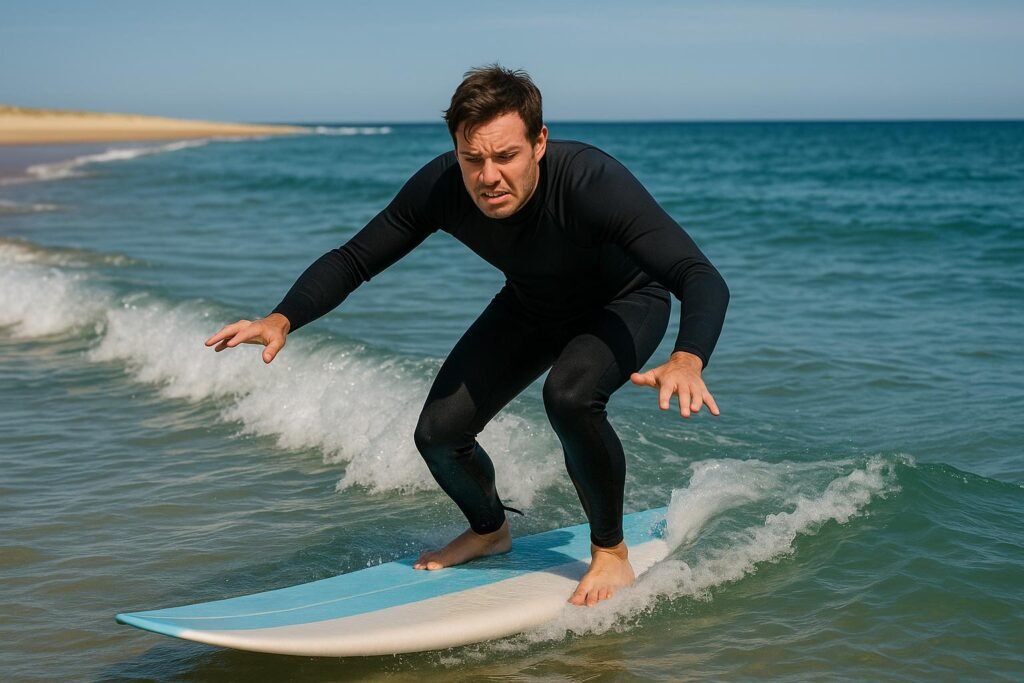
Surfing can be thrilling, but common mistakes often hold beginners back. Here’s a quick rundown of the top five errors and how to fix them:
- Looking Down at Your Board: This affects balance and control. Keep your eyes on the horizon to improve stability and anticipate wave movement.
- Bad Paddling Form: Short, inefficient strokes waste energy. Use long, deep strokes and keep your body centered on the board to paddle effectively.
- Standing Up at the Wrong Time: Timing is everything. Pop up when the wave starts pushing your board forward. Practice on land to build muscle memory.
- Poor Weight Placement: Uneven weight can ruin your ride. Stay centered on your board and adjust your stance based on wave dynamics.
- Ignoring Safety Rules and Surf Etiquette: Follow right-of-way rules, avoid crowding others, and always hold onto your board after a wipeout.
The TOP 5 Surfing Mistakes | Learning How To Surf
Mistake 1: Looking Down at Your Board
One of the most common missteps beginners make is staring down at their board. It might seem harmless, but this habit can throw off your balance and control, turning what could be a smooth ride into an unexpected wipeout.
Why Looking Down Throws You Off
When you look down, your center of gravity shifts forward. This subtle change affects your weight distribution, reducing the pressure on your fins – an essential element for steering and stability. The problem becomes even more noticeable during the pop-up. If your gaze is downward, your body naturally leans forward, increasing the risk of a nosedive.
How to Train Yourself to Look Forward
Breaking this habit takes deliberate effort and practice. Start by working on your pop-up technique on dry land. Focus on a point at or above chest level while practicing; this helps you build muscle memory for keeping your head up. Once you’re in the water, keep your eyes forward and on the horizon. Not only does this help with posture, but it also allows you to better anticipate the movement of the wave. Over time, this upward gaze becomes second nature and sets the foundation for mastering more advanced surfing techniques.
Mistake 2: Bad Paddling Form
Once you’ve nailed where to focus your gaze, it’s time to zero in on your paddling technique. This is one of the most critical skills in surfing and can make or break your time on the waves. Believe it or not, paddling takes up about 80% of a typical surf session, so getting it right is essential. Poor paddling form not only makes catching waves harder but also drains your energy, cutting your sessions short.
Common Paddling Problems
A lot of beginners fall into the trap of using short, choppy strokes that waste energy. Instead of reaching out and pulling through with purpose, they end up splashing around inefficiently.
Another frequent mistake is not fully extending the arms. If you don’t reach forward completely with each stroke, you shorten your range and force yourself to work much harder to cover the same distance. This leads to quicker fatigue and missed waves.
Excessive back arching is another culprit. It increases drag, strains your lower back, and makes paddling unnecessarily difficult. Similarly, letting your legs drag in the water acts like a brake, slowing you down. And if you’re lying too far forward or backward on your board, it throws off your balance and reduces the effectiveness of every stroke.
How to Paddle Correctly
Fixing these issues can turn paddling into a smooth, efficient skill that saves energy and improves your wave-catching ability. Start by lying centered on your board with your chest slightly raised and your head up. This reduces drag and helps you stay aware of your surroundings. Keep your legs together and toes pointed to minimize resistance in the water.
Focus on using long, deep, and smooth strokes. Fully extend your arms forward and pull steadily alongside the board while keeping your elbow high. Timing is key – start paddling as soon as you see a wave approaching. Building up speed early makes it easier to match the wave’s momentum, while waiting too long often leads to rushed, ineffective strokes.
Practice is everything. Spend time perfecting your technique in calm water, concentrating on maintaining a steady, rhythmic motion. Activities like swimming or kayaking are excellent for building the shoulder strength and endurance you’ll need for longer surf sessions.
Your choice of board plays a role too. Larger, buoyant boards offer more stability and make paddling much easier, especially for beginners. Practicing with these can help you develop smooth, efficient strokes, which will immediately improve your ability to catch waves.
If you want to refine your technique further, consider using video analysis or seeking feedback from experienced surfers. Platforms like Adventurism.co provide detailed guides and expert advice to help you master these fundamentals, ensuring your time on the water is both productive and enjoyable.
Mistake 3: Standing Up at the Wrong Time
Once you’ve got your paddling down, the next challenge is timing your pop-up. For beginners, this can be a tricky skill to master. The transition happens in just seconds, and getting it wrong can quickly turn a promising wave into a frustrating wipeout.
Many beginners focus too much on the mechanics of standing up and forget to pay attention to the wave itself. Jumping up too early or hesitating for even a moment can make you miss the perfect opportunity, leaving the wave to roll on without you.
Why Timing Is Key for Pop-Ups
Timing your pop-up correctly means syncing with the wave’s energy at just the right moment. Stand up too soon, and the wave hasn’t built enough power to carry you – it’ll throw off your balance, and you’ll likely fall backward. Wait too long, and the wave’s energy will already have passed, leaving you stuck or unstable as the wave fizzles out beneath you.
The sweet spot? It’s when you feel the wave lifting the tail of your board, but before it fully peaks and breaks. That’s the moment when the wave has enough energy to carry you forward, giving you the best chance to ride it smoothly.
How to Nail Your Pop-Up Timing
The secret is learning to feel the wave. As soon as you sense your board gaining forward momentum – when the wave starts to push you – that’s your cue to pop up. Keep your eyes looking forward as you stand; this helps you stay balanced and focused. Confidence is key, so aim for one smooth, decisive motion.
Practicing on land can make a huge difference. Repeated drills help you build the muscle memory needed to pop up without overthinking. Once you’re in the water, start with smaller, slower waves. These are easier to read and give you more time to feel the wave’s movement. A great drill is to pause in your prone position as the wave approaches, then pop up the moment you feel your board being propelled forward.
With consistent practice – both on land and in the water – you’ll develop the timing and confidence to make your pop-up second nature. Smaller waves are a great training ground to sharpen your skills before tackling bigger surf.
sbb-itb-5a98267
Mistake 4: Poor Weight Placement on the Board
Your position on the board can make or break your surfing experience. For beginners, weight placement is often a challenge, but it plays a crucial role in maintaining balance and control. Misplacing your weight can throw off your ride entirely.
The way you distribute your weight affects everything, from paddling out to catching and riding waves. Getting this right is essential for mastering board control.
How Poor Weight Placement Impacts Your Surfing
When your weight isn’t distributed properly, it can lead to a chain reaction of issues. Uneven weight distribution often results in falls, loss of control, and even increases the risk of injury. It also directly affects how your surfboard performs by altering its balance and maneuverability. For instance, leaning too heavily to one side causes the board to veer in that direction, making it tough to stay on course.
Finding the Right Weight Placement
Once you’ve nailed your pop-up and paddling techniques, refining your weight placement takes your surfing stability to the next level. Keeping your weight centered, especially during takeoff and turns, is key to maintaining stability and control . For most boards, this means lying in a position where the board stays level in the water while you paddle.
When paddling, aim to keep your chest centered over the board’s midpoint. Align your body straight down the middle and keep your legs close together to maintain balance. This alignment keeps you steady and ready to catch waves.
As you move from paddling to standing, weight placement becomes even more critical. Bend your knees slightly and stay relaxed to respond to the wave’s changing dynamics. This stance helps you shift your weight smoothly while staying centered.
Engage your core muscles as you stand up. A strong core is essential for keeping your balance and adjusting your weight to match the wave’s movement. During the ride, focus on centering your weight between your feet. Make small forward or backward adjustments depending on how the wave behaves.
Stay tuned in to the wave’s subtle shifts and adjust your weight instinctively. Over time, these movements will feel natural, allowing you to concentrate on reading the waves and fully enjoying your time in the water. Proper weight placement isn’t just about balance – it’s the finishing touch that ties together all the fundamentals of surfing. A balanced stance improves stability and makes turning more fluid.
Mistake 5: Ignoring Safety Rules and Surf Etiquette
Surfing isn’t just about catching waves – it’s about doing so safely and respectfully. For beginners, ignoring safety rules and surf etiquette can turn an otherwise fun day into a chaotic one. These unwritten guidelines are there to prevent collisions, misunderstandings, and even injuries. Skipping them not only puts you at risk but can also disrupt the experience for others.
Common Safety and Etiquette Mistakes
One of the biggest blunders new surfers make is "dropping in", which means taking a wave that another surfer has already claimed. To avoid this, you need to understand the right-of-way rules. A key rule to remember is:
"The Surfer Closest to the Peak has the Right of Way".
Another frequent issue is snaking – paddling into someone else’s position to steal their wave. It’s not just bad manners; it can create unnecessary tension in the lineup.
After a wipeout, always hold onto your board. Letting it loose can turn it into a dangerous projectile, putting others at risk. Similarly, paddling straight through the impact zone – the area where waves break – can disrupt surfers already riding waves and increase the chance of collisions.
Clear communication is another key element. Signaling your intentions, like which wave you’re going for, helps avoid confusion and keeps the lineup running smoothly.
By understanding these common mistakes, you’ll be better prepared to navigate the water safely and respectfully.
Basic Surf Rules Everyone Should Know
Start by picking a surf spot that matches your skill level. If you’re still learning, choose gentle, less crowded breaks. And if you’re unsure about your ability to handle the conditions, it’s better to stay on shore.
Before paddling out, take a moment to observe the lineup. Pay attention to how waves are shared and make sure to respect the flow. When entering the water, avoid paddling straight through the impact zone. Instead, steer wide to stay out of the way of surfers riding waves.
Beginners should also keep their distance until they can consistently catch waves without disrupting others.
Mistakes are inevitable, especially when you’re learning. If you mess up, own it. A quick “Sorry!” can go a long way in easing any tension.
Lastly, be mindful of local customs. Surf spots often have their own set of unspoken rules, so observe and adapt. As the saying goes:
"Give Respect to Gain Respect".
Conclusion
Addressing these five common surfing mistakes can make a noticeable difference in your performance out on the waves. Whether it’s keeping your eyes glued to your board, paddling inefficiently, mistiming your pop-up, shifting your weight incorrectly, or overlooking safety guidelines, these are all fixable habits with consistent practice and mindfulness.
Beyond improving technique, focusing on these basics is essential for staying safe. Poor technique isn’t just a hurdle to better surfing – it’s also a leading cause of injuries and even fatalities in the sport. By refining your approach, you’re not just enhancing your skills but also protecting yourself.
Making these adjustments can also build your confidence, sharpen your abilities for challenging conditions, and foster a sense of respect in the lineup. Confidence grows through steady exposure to new challenges, maintaining fitness, and putting in deliberate effort . Even seasoned surfers benefit from revisiting and improving their paddling techniques to stay at the top of their game. These small but meaningful changes don’t just elevate your surfing – they also strengthen your bond with the surfing community.
FAQs
How can I improve my balance and control by focusing on where I look while surfing?
To improve your balance and control when surfing, make it a habit to keep your eyes fixed on where you want to go. Looking down at your board might seem natural, but it can disrupt your stance and throw off your stability. By directing your gaze forward, you’ll instinctively position your body in a way that enhances balance and gives you better control as you navigate the waves.
What are the best on-land exercises to improve my pop-up technique for surfing?
To fine-tune your pop-up technique before hitting the waves, start by practicing the motion on land. Lie flat on a surface as if you’re positioned on a surfboard. Then, in one swift movement, push yourself into a standing position. Keep your knees slightly bent and your weight evenly balanced – this helps develop the muscle memory you’ll need when you’re out in the water.
To build the strength and stability required for a smooth pop-up, mix in exercises like push-ups, planks, and burpees into your routine. Adding single-arm planks and knees-to-chest drills can further enhance your balance and flexibility – two essential components for nailing your pop-up. With consistent practice, you’ll find yourself moving faster and with more control during your surf sessions.
What are the key surfing etiquette and safety rules I should follow to stay safe and respectful in the water?
To keep surfing safe and enjoyable for everyone, it’s important to stick to a few key principles:
- Give priority to the right surfer: The person closest to the wave’s peak has the right of way. Avoid cutting in or "dropping in" on their wave.
- Choose your paddling path wisely: Steer clear of the lineup where others are catching waves. Paddle around it to prevent any accidental collisions.
- Stay alert in the water: Keep an eye out for rip currents and be mindful of other surfers and swimmers nearby.
- Always wear a leash: A leash keeps your board from drifting off and becoming a hazard to others in the water.
- Show respect to locals and nature: Be polite to local surfers, and make sure to leave the beach as clean as you found it – pick up any trash or belongings.
These simple steps go a long way in making the waves safer and more enjoyable for everyone out there.