
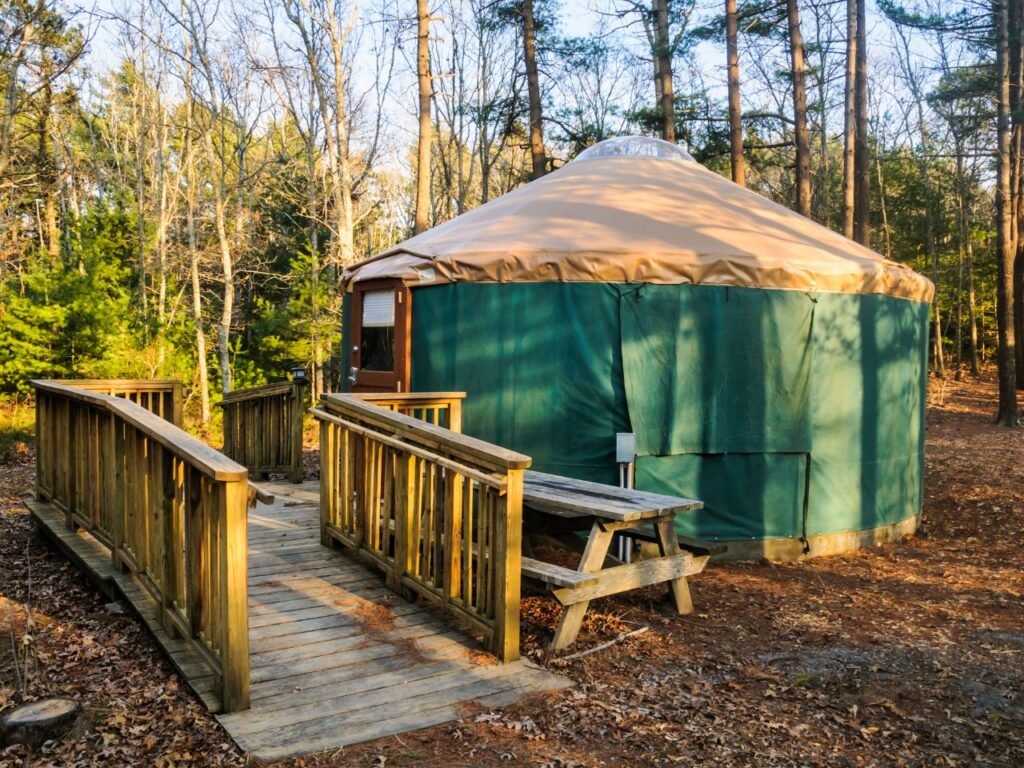
Camping is a practice most people have attempted at least once or twice in their lives. However, the luxuries that come with expanding this experience by choosing a yurt often allow you to delve deeper into a more extravagant experience as opposed to doing “without”.
When viewed from a conceptual perspective, Yurt camping is much closer to “glamping” or glamorous camping than the more normalized practice of traditional camping. Yurts are generally more structurally stable than tents due to the wooden lattice framework used in their designs.
Considering overall structural stability, increased living space, and better ability to mitigate nature’s elements, it’s easy to see why people would choose Yurt camping over a tent. Still, as you might expect, these additional faculties often come at a significant cost.
Is Yurt Camping Popular?
Yurt camping’s popularity is often attributed to people living a lifestyle that typically involves spending vast amounts of time outdoors. Thus, justifying the initial investment required to get a yurt, or its foundation, is challenging. Finding practical uses for owning one throughout the year, rather than just a handful of experiences, is even more difficult.
Considering how the concept of glamping is taking off, people are increasingly keen on enjoying every modern amenity that being in your house could offer, along with the raw enjoyment and mental reset of being in the great outdoors and enjoying nature.
What Kind of Amenities Can You Expect in Yurts?
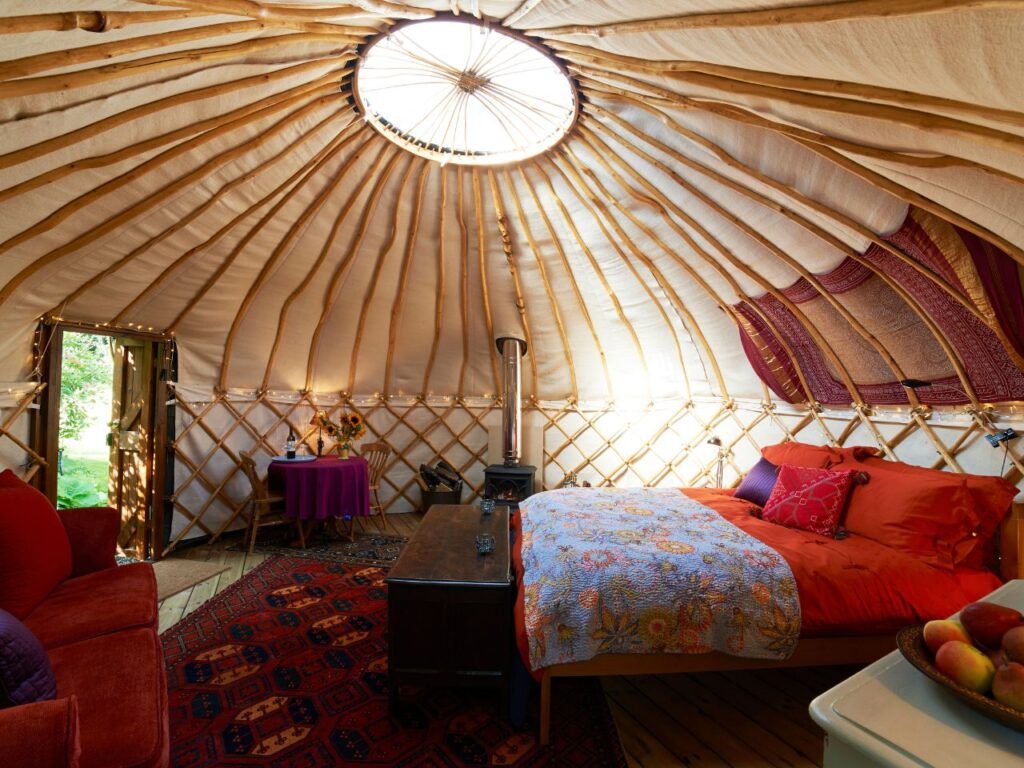
When thinking about camping in a yurt, it might be easier to envision the experience as something you might find when spending a few nights in a cabin, as opposed to a humble tent. This is because most Yurts have features such as regular beds, practical furniture like tables and chairs, and possibly even AC units and portable refrigerators, depending on the size and design of your Yurt.
Another core facet of this experience boils down to how much more room they provide in conjunction with their ability to actively alleviate whatever negative stigmas come with being exposed to the elements from a tent, so tents that are only capable of withstanding warmer weather, Yurts can have heating units included in them, making them viable throughout all times of the year.
What Are the Benefits of Yurt Camping?
As you might expect, yurt camping has a unique subset of pros that make it stand out among other kinds of camping. This could be due to the significant differences in how easy it is to load and transport, as well as in overall stability and cost. There are several reasons someone might want to splurge a bit for this kind of experience.
1. Portable
Suppose you were to compare transporting a Yurt set up to something like a tent. In that case, you’d be hard-pressed to say it’s what people might traditionally call portable. Still, when compared to something that offers all the amenities of an immovable structure, it’s easy to see why someone would say it’s portable. Unless you are Superman, most people cannot casually move an entire cabin, for example.
2. Easy to Assemble
As with most things in life, this comes with a prerequisite. Your traditional Yurt requires you to have a foundation to set the lattice, framework, and the majority of the skeleton that inevitably becomes the Yurt itself. This is more or less like building a house; it will take more time than setting up a simple tent. However, compared to erecting something similar, like a cabin, it takes far less time.
3. Less Expensive to Build
Noting the elephant in the room, a lot of these comparisons are going to be made directly towards things that closely resemble a Yurt, or offer similar boons and protection from the elements, as such, a Yurt will be slightly pricey, but compared to a full cabin, or even a quick build shed which could mimic a fraction of the size without any of the comfort or style, you’ll be saving money, and not skirting yourself on the experience going with a Yurt.
4. Lower Maintenance
We’ve all had to deal with maintenance in one way or another, whether it’s weather causing snow to build on our roof or powerful winds blowing shingles and siding from our home. Yurts require some maintenance as they are a semi-permanent structure, but they aren’t nearly as cumbersome and annoying to build with as other glamping tents.
Unique designs and flexibility in materials make Yurts incredibly durable and easy to maintain. They offer features such as heavy moisture resistance, a shape that prevents snow from building up, and solid foundations that elevate the entire structure off the ground, preventing flooding or damage. You’ll be facing much less upkeep if you go with a well-built Yurt.
5. Flexibility & Strength
As noted above, Yurts are known for their strength and, to a certain extent, their flexibility too. The strength of their design comes from the ability to endure all four seasons (something very few tents can boast) and to withstand harsh winds, potential falls by people, or worse, without collapsing or becoming deformed.
6. Provides a Better Connection to Nature
Because Yurts can be established in the broader amount of areas, and hold up year round, you’ll be able to have a front row seat to literally every season nature has to offer, that means having a nice cup of coffee while watching afternoon showers, letting a nice summer breeze strike you in the morning, or relaxing with some tea and watching animals go about their daily lives.
These unique opportunities are challenging to come by and can grant someone peace of mind or directly inspire them to make changes in their lives to become who they aspire to be. Nature can rally us in the most profound ways, and a Yurt can be the key to walking through that doorway.
What Are the Disadvantages of a Yurt?
Although Yurts have many outstanding features, some disadvantages might make or break the decision to buy them in the first place. We want to ensure we cover everything so you can have a more informed decision.
1. Poor Insulation
While Yurts can be a great many things, insulated does not really find itself walking into most of those conversations, and that is purely by design, as you do need to make inevitable tradeoffs when making a structure that can endure the harshest elements, which does innately mean the more casual ones aren’t as enjoyable.
Unless you get a Yurt with panels and windows that can be opened or removed, you may find yourself getting incredibly stuffy in the warmer seasons. This can be alleviated with a Yurt that addresses the issue, but such products are usually costly.
Alternatively, you could also opt to get a portable AC unit, but you’d also be reliant on a method of power. Some impromptu ductwork to facilitate the unit itself, which might be worth the time invested for an authentic glamping experience, but if that’s not your cup of tea, a Yurt might not be right for you.
2. Limited Space for Large Families
While Yurts are fairly large structures, they are made to provide an almost luxurious experience for a handful of people, not to accommodate as many people as you can cram inside the Yurt itself, to that end, it’s less than ideal for prominent families, or larger friend groups because the entire point of the Yurt is to have comfort and excess, not minimalism and accommodating numbers.
It goes without saying, then, that you can either opt to get multiple Yurts, which is a very respectable, if not expensive choice in some cases, or see a situation for what it is, and get a few large tents, focusing more on what you can do outside of where you sleep, than inside it.
3. Moisture Issues
Being able to endure the elements does not necessarily mean you take them entirely in stride. At the same time, a Yurt can keep you from getting rained on, and with higher foundations, prevent you from getting flooded out. You may encounter entirely different setup problems, such as moisture buildup.
The moisture could be caused by back splash from nearby water sources, evaporation depending on humidity levels, or any number of different possibilities. However, the result is the same and ultimately incredibly annoying to deal with, as it’s not something you can truthfully ignore.
Moisture buildup in your Yurt can cause damage to the inner materials, given enough time, or become bad for your health when things like mold are allowed to ferment over time, especially between uses and when forgotten.
4. Hard to Get a Loan
While you likely won’t need a loan for a smaller Yurt, the larger, more local variants are expensive and may require a substantially larger budget. We’re talking upwards of fifty thousand dollars for what could be viewed as a small home.
5. Challenge With Building Permits & Utilities
Keeping in step with the larger, more home-like Yurts, you’ll need to get unique permits, permissions, and even inspections to guarantee the structure is safe to inhabit, depending on where you live, and what local laws are imposed on such structures.
Even after you go through this process, you will need to be aware that running water, electricity, heat, and even sewer facilities in this domicile can present their own set of issues. These issues can open a proverbial jar of worms that most people aren’t ready for if they struggled with the initial cost.
What Do People Do in Yurts?
A fascinating question: anything you’d do in a typical home, cabin, or lodging doesn’t have any specific activities to speak of. Still, you could play board games, lounge about, enjoy the weather and scenery without getting directly involved, or opt to sleep deeply, enjoying the sounds of nature.
How Much Does It Cost to Rent a Yurt?
If setting your own Yurt up isn’t an option for you, then renting most definitely can be, with prices ranging from a humble $50 a night for your bare bones, brass tacks experiences, or up to $500 for premium, state-of-the-art Yurt lodgings, which are usually what people think of when they truly envision glamping.
Do Yurts Have Electricity?
Yes, Yurts can have electricity, but it isn’t something they come with innately. You can get power flowing through a Yurt in a myriad of ways, whether it’s a generator, an off-grid setup using solar panels and other methods, or having electricity run directly to the building itself.
What States Allow You to Live In a Yurt?
Currently, five states would allow a Yurt to be considered a year-round home. They are Alaska, California, Colorado, Oregon, and finally New York. Before setting up your Yurt and spending any money, check your local state laws and guidelines, as you may not be able to do so in your area specifically.
Final Thoughts
While certain aspects of what a Yurt is can be confusing, the bottom line is that a Yurt is a reinforced structure that is tent-shaped. While some Yurts can only qualify as a temporary structure, some variants are made to be homes (often costing a fraction of the price of a normal house). Due to this, some people may not fully understand those differences. Hopefully, this has provided some clarity on the possibilities presented by Yurts, both temporarily and as a permanent home solution.