

When you are out hiking, it is important to make sure you know what is going on around you. This is for myriad reasons, but the most important is to help you avoid injuries while hiking. Even so, it is important to know the most common hiking injuries and how to deal with them if you have any.
The most common injuries you can incur while hiking are often ones that could have been prevented with a little time and ample preparation; anything ranging from strained tendons to poorly applied topical treatments meant to stave off severe sunburns or bug bites can usually be prevented before they even begin.
To make the most out of each problematic injury’s prevention, we’ll go over each one individually and provide accurate ways to prevent them, as well as how to handle them if you’ve already succumbed to them (let’s face it, we all do research after the fact, and that’s perfectly fine!).

Most Common Hiking Injuries and How to Treat Them
Navigating this list of maladies, we’ll go from the easiest to handle to what might be more difficult, or, in a worst-case scenario, may even require a trip to the local emergency room.
It’s imperative that, when gauging any of these situations, you be honest with yourself and your medical abilities; attempting to treat something outside your scope could have serious ramifications for you or your loved ones. It is always better to be safe than sorry!
1. Insect Bites and Stings
Navigating the great outdoors is difficult enough all on its own, but doing so with legs and arms absolutely decimated by mosquito bites, or with several ticks attacking you, can make a pleasant stroll through the woods an absolute nightmare for those unprepared for the wilds of nature.
There is no shortage of different preventive sprays you can use to help keep the creepy crawlies away. Still, you’ll want to choose ones that lean towards being natural and, even more importantly, don’t have foreign scents that can disturb local wildlife.
In the unfortunate event you do get bitten, you’ll want to sterilize the area with soap and water when you have access to them, apply an ice pack or a cold cloth to the affected area, then follow up with any preferred anti-itch creams to help you overcome the irritation that follows.
While it should be common sense, any itching, scratching, or rubbing of these areas is more likely to make them worse than to improve them. This specific sequence of treatments is only valid for mosquito, ant, and tick bites; more severe insects, like spiders, should be carefully monitored and reported to a doctor, especially if the wound itself becomes discolored and painfully swollen.
2. Sunburn
Ah yes, the grand equalizer for unprepared daytime hiking, sunburn, again, one of the more preventable issues that can befall you, as you only need to bring a preferred sunscreen, or organic treatment method to help prevent it (think aloe vera creams and the like). Sunburns can range from mild to incredibly painful, depending on your level of exposure.
The articles of clothing you wear can also help prevent direct sunburn; options like long-sleeved shirts, wide-brimmed hats, and being mindful of shady resting spots can help prevent sunburn in most cases.
Treating a sunburn is as simple as moisturizing any particularly damaged areas and resisting the urge to scratch, itch, or, worse, peel any damaged skin, as doing so will make the areas even more exposed and tender, increasing the chances of infection or irritation in the long run.
3. Back Injuries
If you’ve ever been on a hiking trip, or even seen someone going on one, you’ve likely seen them toting the sometimes comically sized backpacks that carry everything they do, and sometimes don’t need for the trek ahead, the problem arises when you utilize said backpacks poorly, either by overstuffing them, or not taking into consideration how they need to be seated on you to prevent injury.
As you might have guessed, backpacks are a pivotal item when it comes to hiking, but what most people fail to realize, is that these backpacks can only have so much weight in them before they become a detriment to your health and safety, the most notable way to prevent this is following the “20% rule”, which entails a backpack should never exceed 20% of your personal body weight, or 10% for a day hike.
Failure to do so will put unnecessary strain on your body, knees and back, quickly increasing your likelihood for injuries, even more importantly, the same backpack needs to have the straps accurately adjusted to prevent it from swaying freely while you are on the move, as these dramatic jarring movements can make your muscles work overtime to keep you balanced, and again, end up injuring you in the long run.
Suffering from a back injury can take time to heal, and the best medicine for that is a nice rest, a warm compress, and any pain relief medication that is safe for you to take (not all pain medications are the same, and some might overlap with underlying heart and health complications.
4. Muscle Strains
Grasping how you might injure yourself while carrying things is a nice transition into the next topic: muscle strains. The concept of “not overdoing it” or going “overkill” can be just as bad as not preparing at all, so we’ll skip the song and dance and get straight to stretching.
In most cases, muscle strains can be directly attributed to not adequately stretching any specific muscle group before engaging in the rigorous activities that a proper hike entails; everything from shoulder shrugs to loosen up, or lunges for those awkward stretches you’ll need to hit to go from gap to gap, can prove imperative to keeping you from feeling it the next day.
Knowing how far you can push your body. Personal limitations also plays a large factor in how likely you are to put yourself into a position of getting muscle strains, if you work from home, or at a desk, and decide you want to jog up a hill over the weekend, there is a large chance your relatively immobile daily life can cost you in the long run, so be mindful of how you pace yourself when dipping your toes into the world of hiking.
Similar to back pain, muscle strains should be treated with appropriate rest, supplemental pain medication, and hot or cold compresses, depending on the type and location of the injury. If the severity of the muscle pain only worsens after you get home, you may want to see a doctor, as you may have torn the muscle instead of straining it.
5. Shoulder Injuries
Shoulder injuries are most common when attempting to lift something for a long time while hiking, or when overexerting yourself at odd angles to keep your balance, or when you slam into the ground on a particularly nasty fall.
You can also get them from an overloaded backpack, but we’ve already covered that side of things so that we won’t delve too deeply into it. Instead, we’ll focus on preventative measures tailored to carrying too much first, then go into handling nasty falls
Assuming your shoulder pain is from carrying something for too long (like your backpack being positioned poorly), you’ll want to invest in padding for the straps themselves or purchase a backpack with ample built-in padding. Still, again, your backpack shouldn’t be so heavy that this is a normal occurrence.
If the pain is directly related to a bad tumble and landing on your shoulder directly, you’ll want to do your best to alleviate any extra weight from it, making sure to check the severity of the damage by gauging how bad the pain is, and check whether or not the pain is in your muscle or bone, as damaged muscle will be sore for a few days but heal. Still, a cracked clavicle will require a doctor visit.
6. Ankle Sprains
Ankle sprains are the kind of injury that isn’t inherently due to something you did wrong, more so occurring when you step poorly or attempt to catch yourself from falling; regardless, you can prevent ankle sprains by wearing shoes that have a solid amount of grip, and carefully gauging the terrain of where you are walking in tandem with what the weather for the area is.
The kind of shoes you wear should fluctuate pretty strongly between hiking in an arid terrain or hiking in a damp forest; for example, these are two different kinds of shoes, one protecting you from walking on miles of rocks and jagged surfaces, and another being not only comfortable enough to keep your feet from getting moist, but also preventing you from slipping on a mossy rock.
In either scenario, careful shopping should be done, and taking time to accurately plan your footsteps, especially when you are navigating areas that are sloped or could come loose beneath you (think clusters of pebbles or other debris), a trekking pole can also help reduce your chances of falling by giving you a secure point to brace yourself while seeking stable footing.
Should you suffer an ankle sprain, you’ll want to do your best to keep pressure off the ankle and get evaluated, taking care to wrap it and take pain medication to make the pain more bearable. Raising the ankle can also help reduce swelling.
7. Knee Injuries
While mobility-based injuries are some of the worst you can get, knee damage is in its own unique place, as there are several ways you can get them; everything ranging from poor weight distribution from a bag, awkward walking gait, or particularly nasty falls where you happen to collapse onto the knee itself can all bring you into the same umbrella of pain.
As we get older, putting weight on our knees for long periods can lead to pain. Combating this can be as easy as ensuring we are as healthy as possible, measuring our steps, and, if needed, using things like knee braces to keep weight distribution as safe as possible.
If these preventative measures (or lifestyle choices) aren’t enough, and you still manage to get injured, you’ll need to take the same precautions as above (and admittedly large the same in most cases), keeping yourself off the knee as much as possible, and taking whatever suitable pain medication you can to keep the pain to a minimum.
Falling on the knee itself can cause a different kind of pain, with injuries that may supersede normalized treatment (think falling and taking the brunt of your body weight, directly on a rock); this can easily shatter your knee, or cause it to slide out of place, which will again require you to visit a medical professional to avoid serious damage in the long run.
8. Wrist Injuries
Finally, while relatively unlikely, wrist injuries are almost always caused by falling and attempting to catch yourself, at least when hiking. To that end, the most preventable way to avoid them is to watch where you step.
You can be creative and injure your wrist in other ways, for example, carrying a water bottle, tote bag, or really anything of sufficient weight for a long amount of time and end up injuring your wrist. Still, you’ll probably feel your wrist gradually getting fatigued and achy long before serious pain becomes something you’ll have to contend with.
The downside to wrist injuries lies in the fact that your wrist contains a lot of very sensitive nerves and bones that can make your daily life incredibly difficult should you manage to injure them, with even the simplest jobs like writing becoming difficult should the pain be bad enough.
Effective treatment of wrist injuries truthfully boils down to the severity of the injury in question, if it’s only slightly tender, you could probably get away with not using the arm itself for a few days, and be capable of going about your life, more traumatic falls, potentially dealing with a sprain, or worse broken bone will require it to be set, elevated and sometimes even operated upon.
9. Eye Injury
Anything involving damage to your eye is terrible even at the lowest level, because most of us rely on our sight for every aspect of our life, and even having damage to just one eye can render you immobile due to the pain, or hinder your ability to balance yourself.
While hiking, an eye injury is most likely to occur when a foreign object happens to fly into your eye, like leaf litter, a bug, or sand, but can be far more serious when something like a twig, or branch comes at you unexpectedly (think in regards to turning around to check your surroundings and not seeing a branch you are walking through), these injuries can be very painful. Still, they can be prevented by wearing simple eye protection.
While you aren’t directly required to wear sunglasses when hiking, they do give you the additive benefit of preventing you from being blinded by light and giving you a shielding layer of simple deflection from most things that could potentially damage your eyes.
If a bug, sand, or something small gets in your eye, you can usually rely on washing the irritant out with some simple water or eye solution and get back to your daily life. Still, foreign objects poking your eye should be taken more seriously, especially if you can physically feel an abrasion on the eye itself rubbing against your eyelid (instead of a smooth feeling when you blink, it may feel coarse, or as if there is sand trapped inside your eyelid).
If the latter proves to be your situation, you’ll need to get your eye examined for any potential damage or objects lodged in it. Should you suspect something, do not rub the eye!
10. Head Injury
Now we are truthfully getting into serious water, as most head injuries vary significantly in severity, and if you do suffer a particularly nasty fall, or your head happens to smack a log, or rock in a tumble, you could have a concussion, and not respect how badly you are injured, potentially putting your life in danger.
We’ll skip the more basic concepts and focus on concussion-related injuries, as treating cuts, bruises, and other minor injuries is straightforward, with cleaning, disinfecting, and bandaging often sufficient to keep them from worsening.
If you hit your head hard, for any reason, one of the first things you need to do is tell someone; it doesn’t matter if it’s a friend, relative, or someone nearby, because you may quickly lose the ability to do so and not get valuable help should you lose consciousness slightly after.
Next, you’ll need to check yourself for the onset of a concussion; anything from a heavy pressure in your head to feeling off balance, sick, or difficulty seeing straight can be clear indicators that you are indeed getting a concussion.
These symptoms are often accompanied by extreme levels of fatigue spontaneously, or even ringing in your ears; your ability to process information or understand where you are can also be hindered, which is why it is pivotal to tell people what’s happened as soon as possible, with slurred speech, seizures, or even passing out being distinct possibilities too.
If possible, you’ll want to immediately seek help and get yourself to an emergency room if you experience any of these symptoms after hitting your head.
11. Cuts and Bruises
Dialing things back from being on such an extreme level, cuts and bruises can be treated relatively quickly and easily, with cuts often just needing to be cleaned with some regular soap, and applying a disinfectant of your choice to prevent the wound from becoming worse, finally bandaging it to prevent foreign objects from getting inside and irritating it.
Bruises are also simple to treat, with the ideal method being applying an ice pack to the area and elevating it if possible, or utilizing the afflicted area as little as possible, giving it time to stabilize normal blood flow, and alleviate any additional pain you may be experiencing; in both cases, some simple over-the-counter pain medication will work wonders.
It should go without saying, but the treatment listed above is for run-of-the-mill cuts, almost bordering on scrapes, not large lacerations that have profuse bleeding, or where notable coloration changes are happening between the layers of damaged skin. A general rule of thumb would be that if the cut is deeper than a quarter of an inch, you’ll probably need stitches.
12. Foot Blisters
Anything foot-related can be horrible, as it can impede your mobility and directly impact your overall quality of life. Foot blisters are no exception, but thankfully enough, they can typically be prevented by wearing the right shoes for the area you plan on hiking and engaging in appropriate foot care.
Keeping your feet dry, clean, and well cared for will help prevent foot blisters from taking root in most cases. Still, if you opt to push the limit, despite feeling intense foot pain, or ignore the friction from improperly fitted shoes, you can definitely acquire some nice bumps for your time.
When a foot blister does take root, all you need to do to care for it is clean the area with mild soap and place a bandage over it to prevent any additional irritation, with ointment applied before the bandage.
One of the worst things you can do for a blister is to pop it, or prod at it, as the blister itself is your body’s natural way of protecting the inflamed and damaged skin, worse still, if you cannot control yourself, or accidentally rupture the blister, you are actively increasing your chances for infection, and making the wound more painful, so do so at your own risk.
13. Dehydration
Regardless of if you are hiking in a forest, or in a desert, you’ll need to keep yourself hydrated so that your body doesn’t give out on your, or leave you spiraling into potential heat exhaustion, you can do this by simply taking routine sips of water over the course of your journey, being careful not to chug your water as this is also just as bad as not hydrating at all.
14. Hypothermia
In just the same way that being exposed to heat for too long can cause heat exhaustion (which we’ll go over below), being exposed to the cold for too long can cause you to go into hypothermia, a condition where your body begins to fail to regulate its internal temperature and begins to shut down.
Mild cases of hypothermia will have you shaking, jittering, and being unable to stop of your own accord. Still, as it worsens, you’ll begin to feel confused, with your muscles potentially locking up or even causing you to pass out. For these reasons alone, you should try to avoid hiking in cold conditions without a partner.
If you or someone you are with is showing signs of hypothermia, you’ll want to seek refuge off the trail in a heated location, or immediately head back, alerting friends, family, or authorities to your location and setting up a timed check-in system. Hence, you or your partners get the help you need.
15. Heat Exhaustion or Heat Stroke
Heat exhaustion is quite literally the inverse of Hypothermia, as it occurs when your body becomes too hot. You don’t adequately hydrate or seek shade from the heat in time; much of the problems you deal with remain the same as well, with general confusion, loss of consciousness, and irregular heartbeat becoming the major causes for concern.
If you feel yourself slowing down, losing balance, or breathing strangely while hiking in the heat, you should immediately seek a shaded area (especially if you are sweating profusely, or not sweating at all even though you should be), drink water, and once again, alert someone to your location and condition.
While you may see some strong repetition in the cited “tell someone” logic behind most of these treatment methods, it’s because the underlying condition will potentially have you not in your right state of mind, meaning you cannot or will not be able to get help yourself adequately, and thus will be left to the elements, in an attempt to avoid this, it’s best to inform anyone, and everyone possible.
16. Sprained or Twisted Fingers
Injuring your fingers will greatly impede your ability to get anything practical done while hiking, never mind how much of an annoyance it can be in your daily life. In most circumstances, sprained and twisted fingers occur again while attempting to catch yourself from a fall or to clamber up a rock face or a fallen tree.
Regardless of how you manage to hurt your fingers, unless they are noticeably dislocated or out of position, you can usually get away with icing the afflicted areas for roughly twenty minutes and attempting to splint them for stability, usually against a non-injured finger if possible.
Bracing it against a normal finger will prevent further harm and provide a resting position that lets you comfortably elevate the affected fingers to help prevent swelling and lessen pain during the healing process, before other pain medications take effect.
17. Bone Fractures Due to Slipping and Falling
While it should be common sense, if you suspect you’ve broken a bone, or even fractured one, your best course of action is to visit an ER to get the appropriate treatment needed immediately; this is doubly so in cases where the bones can be observed either poking or worse protruding from your skin, increasing the urgency behind either situation.
If you’ve broken a bone, for instance in your arm, you’ll want to attempt to make a makeshift sling with a jacket, coat, or shirt to keep the arm from swinging, and immediately leave the trail, calling for help as you make your way out, noting how far into the trail you are, and your expected arrival at the entrance.
If it is a leg bone that is broken, and you cannot move from wherever the fall happened, you’ll want to use your phone to call for help, citing how far into the trail you are, try to remember which side of the trail you fell on (if you’ve tumbled out of view), and pace your breathing to help maintain a level head. At the same time, you wait for help to arrive.
You may have noticed in almost all of these scenarios that being capable of reaching out to someone who isn’t accompanying you is a recurring theme; as such, you shouldn’t ideally go for a hike without having a phone on you, even if unactivated, as even cell phones that are off can typically reach EMS services.
18. Foot Pain
Despite being generalized, any foot pain can be hard to deal with, especially if you haven’t the faintest idea of what originally caused the pain, if it suddenly happens while on the trail, your best course of action is to attempt to utilize a nearby solid, unrotted stick (you can note if the stick is capable of not only supporting your weight, but that it isn’t at risk of breaking due to being infested with termites or something similar), and using it as a trekking pole to aid you on your way back, before being able to examine the foot more closely.
Depending on what is going on, whether or not the pain is skin deep, or something potentially affecting a muscle, or worse, a bone, should help you choose which method of treatment will work best, while sounding a bit dated, you know your pain tolerance better than anyone, if the agony you endure is outside of what you can handle daily, you should get checked out.
How Can You Prevent Hiking Injuries?
The best way to prevent hiking injuries ultimately boils down to how prepared you are to anticipate which ones are most likely to happen to you. This can be summarized in most cases by gear, clothing, footwear, and, finally, how vigilant you are about your surroundings.
1. Consider Bringing a Hiking Pole
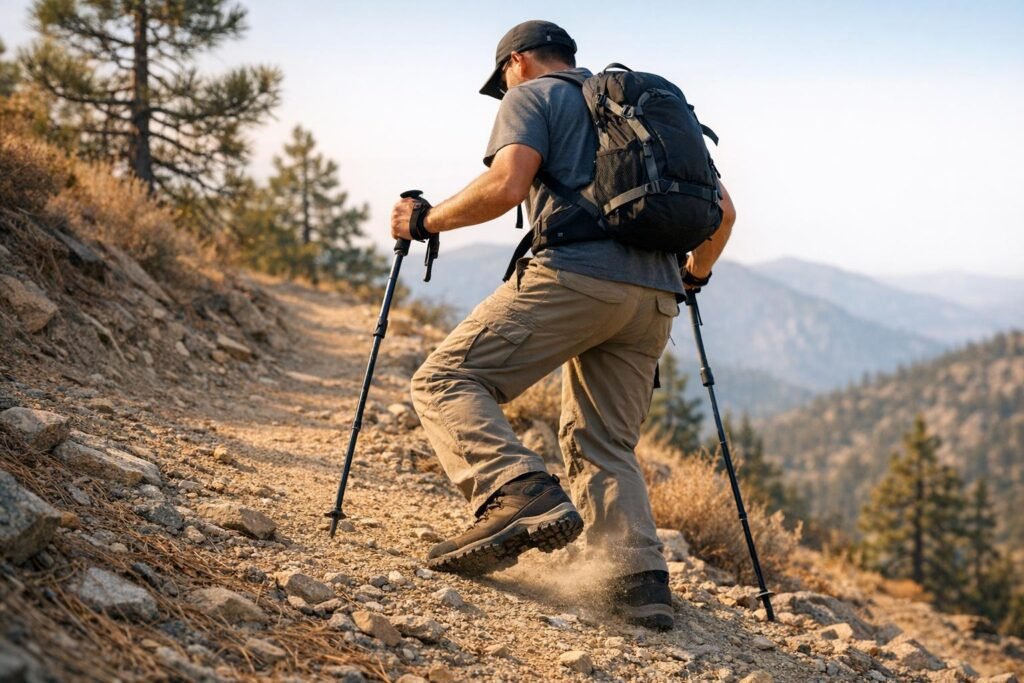
A hiking pole, or trekking pole, while simplistic in nature, is one of the most valuable hikers’ companions you can bring, because on a good day, you can use it to help you take some weight off your stride with every step. Still, in dire conditions, it can serve as a makeshift crutch to help you hobble into some much-needed help.
Effective use of a hiking pole will also allow you to maintain proper balance even on slippery, uneven surfaces, or where your foot might struggle to find ample support, for instance, wriggling in between smooth stones and catching traction on the earth beneath them.
2. Lift Your Legs
Getting into the rhythm of stretching your body and legs will help prevent strains and other overextension injuries because your body will be better prepared for the motions and ranges of motion you’ll need to navigate the winding trails.
You can also attribute this to how you walk, as dragging your feet when rocks, branches, logs, and any number of obstacles can clutter your pathing will quickly escort you to a face-to-face meeting with the floor, so honor what your parents likely said when you were growing up, and “Pick your feet up when you walk!”
3. Wear Proper Gear
In much the same way you wouldn’t want to show up to the beach wearing a feathered coat and snow boots, you don’t want to show up to the hiking trail wearing beach shorts and flip-flops, primarily because improper clothing and gear increase your chances of getting hurt or impeding you as you attempt to get to your destination.
As a prime example, while flip-flops will feel comfortable initially, their inability to gain traction on uneven surfaces and their complete lack of protection for your feet will leave you open and exposed to any stray stick, stone, or bug that might assault you. At the same time, you struggle along, making the entire journey less enjoyable, and obviously dangerous too.
4. Prepare Your Body
We briefly glanced over it above, but Rome wasn’t built in a day, and neither is a body capable of strutting through the wilds like you own the place, especially if you have been working on a nice monitor tan all week.
Taking time throughout the week for simple workouts, stretches, and other healthy activities can help prepare your body for the journey ahead, with the benefits increasing if you add additional stretches right before taking off.
Doing so will warm your muscles up and prevent them from straining or locking up when you are on the road, actively reducing your chances of falling and injuring yourself and helping you avoid most of the issues we’ve discussed thus far.
5. Have Good Form or Posture
As sad as it is to admit, most of us do not have good walking form, and even our resting posture could use some work. At the same time, we may not intend for our spine to rest in an “S” shape naturally; society and work often make things that are inherently good for us second nature, and, as such, we need to take time to relearn them.
In the most basic of senses, walking with good posture is as simple as keeping your eyes forward, keeping your shoulders squared and keeping your core firm (not flexing), while occasionally letting your arms have some subtle movement, in practice this seems simple, but how you lift your feet, and conversely let them fall between each step adds up gradually into having good, or bad posture.
Walking poorly for miles, especially in shoes that may not be made for the area you are hiking, can absolutely destroy your back, knees, hips, and feet, so doing a bit of research, or perhaps referencing a YouTube video to really get a solid understanding of it might be your best course of action if you aren’t too confident about your stride.
Final Thoughts
Preventing hiking injuries is a simple enough task with a little forethought. Still, consistency with routine, micromanaging how you navigate trails, moving your body, stretching before going, and measuring carrying capacity in tandem with good walking form can be a lot, especially to newcomers, so take your time, do your research, and be safe!