

Finding what boat best suits you is easier said than done. More often than not, it takes time, patience, and a load of research to ensure you are getting what is right for you.
Suppose you aren’t the most knowledgeable boatman at the dock. In that case, you might not be able to tell the difference between a canoe and a rowboat, or any other boat, for example.
Between these two, the most significant differences lie solely within the method of propulsion, or how they move in layman’s terms.
At a base level, canoes are usually smaller, more nimble boats that are propelled forward using a paddle. On the other hand, a rowboat is considerably larger than a canoe. You paddle backwards in it, using an oar instead.
In contrast, there are several significant differences between them; the biggest ones are size, travel distance, weight, stability, rowing direction, and cost. Below, we’ll be going over these differences in detail and figuring out which one will put you at ease while traversing lakes or seas (not that you need to go to the open sea with either, or that it’s generally a good idea).
Canoe vs. Rowboat: Which One Is Right for You?
The best choice of boat for you is going to depend on what you plan on using it for, where you are going, and what end goals you have upon reaching your destination, assuming there is one. Suppose you are looking to go fishing, for example.
In that case, you might want to lean towards a rowboat, as they are typically wider and capable of carrying more gear, making the entire trip more enjoyable, whilst a simple exploration via water would probably make a canoe more ideal, especially if you are looking at more of a round trip, or shorter duration.

1. Type of Water Each Can Go On
Generally speaking, each boat can more or less safely go into all types of water, but it’s how long you can remain in these places safely, or tread in said waters that really allow one boat to shine over another, alternatively, how easily they navigate said waters that really shows which one you’ll want to lean towards.
Canoe
Canoes are built to handle any calm, flat waters you might find yourself exploring or fishing in. They can also be made to contour themselves to whitewater. Still, these are more specialized variants, not something that is innately part of all canoes, with their bottoms being flattened out to prevent sinking in the event of it flipping over.
There is also a specific kind of paddling stance people need to opt for to overcome any rogue waves they might come across safely but that is something that needs to be detailed on its own. Be aware that different techniques are utilized to bypass certain shortcomings. These can be taken to sea, but understanding stability can be an issue.
Rowboat
Being a larger, sturdier, and more roomy vessel means they slightly less inclined at being good in shallow waters, but make them the ideal choice when waters are more hectic with a hull design that grants them greater stability in open water, and an easier way to traverse and maneuver in it, especially when the seas themselves are proving rather turbulent.

2. Investment
Cost can be a significant determining factor when it comes to any shopping, and boats are no exception. Suppose you are looking to spend as little as possible to get yourself out in the open waters. In that case, you’ll more than likely be wanting to get yourself a canoe, as the average cost is significantly less than that of a rowboat, with most price points being focused around the overall size.
Still, specific designs, material choices, and other factors can see the opposite being true. Typically, the price ranges biggest factors come in the form of length, material, and finally brand, more than anything else, with these values remaining consistent for both canoes and rowboats.
Canoe
On average, a cheap canoe will run you about $600, which isn’t exactly a drop in the hat (or lake). Still, if price was your greatest concern, then this might be your best option. Canoes, like most boats, can be customized quite a bit, with different design types making them even more expensive, and durability changing things considerably too.
Rowboat
Being the larger of the two, you can expect to spend more money on raw materials to make the boat in the first place. You can easily expect to pay upwards of $2,500 for a rowboat from the entry point. Things like size, stability, and durability add even more weight to that initial investment. Capping out with things like brands and additional storage spaces can put your final cost relatively high if you are trying to save money.

3. Gear Storage
If you are going on an adventure for a few hours or a few days, you’ll generally want to take some provisions and equipment with you, it could be enough food for a lunch at your designated location, or your entire fishing rig, with a cooler to store anything you catch, regardless, you’ll need room to store all of these things, and even more importantly, a boat that can safely handle the excess cargo without tipping over with you in it.
Canoe
Traditionally speaking, you aren’t going to be able to put a whole lot of additional weight on a canoe aside from yourself. This is partially because there isn’t a lot of room in the design of most canoes. The other side makes it more prone to capsizing if the weight isn’t exceptionally balanced in the boat. With canoeing itself being a balancing act, it only makes sense that you wouldn’t want to make that any harder than it already is, especially if it costs you stability and speed.
Rowboat
The premier choice of fishing enthusiasts or campers around, a rowboat will allow you to haul a vast majority of your fishing essentials, and perhaps some extras, to remote locations. This makes them perfect for getting to exclusive camping spots, or extended fishing trips, (especially if you don’t mind multiple trips to bring tents, and such).
The greater issue with this method of trip planning will come more with how heavy your rowboat is when you need to carry it anywhere on land, assuming there isn’t a dock where you intend to stop.
4. Stability
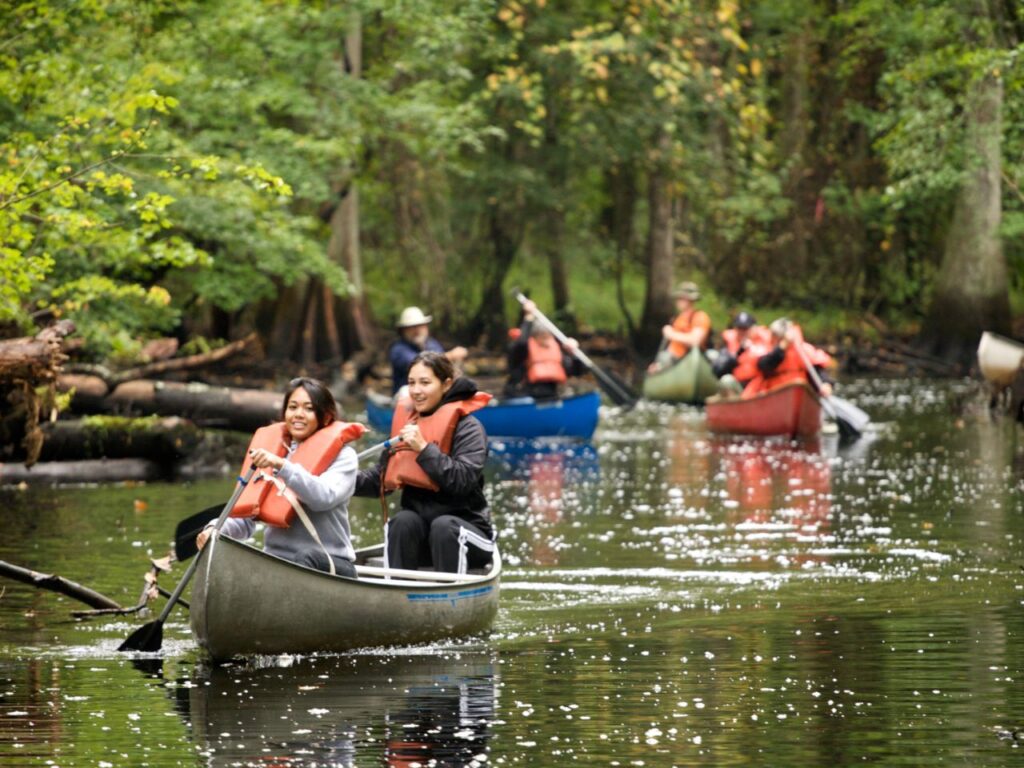
Ensuring you don’t flip over and need to finesse yourself back into your boat is something everyone should be innately concerned with. To that end, you’ll want a vessel that not only meets your needs but also matches your physical capabilities. Canoes, for example, require you to constantly measure your balance, making it a much more physically demanding adventure than trusting in a rowboat for stability, for the most part, over your actual muscles.
While it needn’t be said directly, both kinds of boats are going to be “stable” enough on their own. Very few people would purchase a boat that is inherently prone to sinking. Also, some design choices may make the boats less stable overall. However, it’s worth noting that narrower boats are more likely to tip than shorter ones due to weight distribution and other factors.
Canoe
If we were to summarize stability from a canoe’s perspective, there is a greater emphasis on individual technique than on the overall design of the boat. In most cases, canoes are exquisitely crafted, so you can’t speak to that as a reason it might be less stable than a rowboat.
Essentially, you will be tasked with exerting a certain amount of effort to keep the canoe afloat. This effort is amplified when factors such as water conditions or turning are taken into consideration. If you aren’t the most fit person or have physical conditions that limit your ability to utilize your core or back, you should avoid buying one.
Rowboat
Rowboats can be a little daunting when you initially set foot in one, feeling as if the entire thing might put you into a Looney Tunes cartoon at first glance. However, after you’ve settled in, you’ll note that the whole boat is more stabilized on its own, and less effort on your part is needed to remain above water. Even more to that end, some rowboats even have unique add-ons called transoms, which will allow people to safely walk in the boat, without needing to worry about the weight distribution potentially flipping them over.

5. Difference in Speed
Getting where you want to be in style, safety, and with speed would be the three most admirable traits you can look for in a boat. Still, if you did want to lean towards getting there in a hurry, there are some rather key differences between these two you’ll want to be aware of, with the first being the individual amount of effort required to get from one place to another, in each boat.
Canoe
Because canoes are forward-facing boats that are propelled with you alternating sides, you paddle from, you’ll find it takes more effort from you to maneuver the oar from one side of the boat to the other. You will also be juggling the amount of effort you put into balancing the boat itself, and then repeating this cycle from side to side.
As such, even the fittest people around will average about 2.6 knots, making it relatively slow all things considered, and you require much more muscle dexterity to keep your boat on course and moving forward.
Rowboat
In terms of raw speed, the rowboat dominates this section because you utilize more core muscles in your back per stroke, making you capable of generating much more explosive power per row than you can in a canoe. You will also require less consistent strain in balancing, allowing you to put more into each row by association.
Depending on the length of your boat, how many people are rowing, and more, some boats have been known to achieve upwards of 7 knots. This speed is double that of a canoe, even with the additional weight of whatever spare gear you want to include in it, which is quite impressive considering.

6. Type of Motors
While there are certainly more than two types of readily available motors for boats, the two most common ones are trolling motors and electric motors.
One of these motors makes an appearance due to its more stealthy form of operation (trolling) and concise movements, making it ideal for fishing; the other prioritizes speed, meaning you take an obvious sacrifice on control and general silence.
Canoe
Because canoes are relatively low-weight boats, you are better off utilizing an electric motor with one, as the idea is more focused on getting from point A to point B, rather than casually exploring areas and looking for choice fishing spots.
Rowboat
In a rowboat, you can make full use of everything a trolling motor brings to the table, including the quiet approach, reduced sound operation, and precise control in direction, making it perfect for the novice or adept fisherman alike.
Alternatively, they can make great use of electric motors as well if getting around quickly is more your style. The ability to carry weight and having more flexibility in either case makes the rowboat stand out slightly more than the canoe when it comes to motor choices.

7. Distance Each One Can Go
Traveling around is one of the most significant aspects of using either a canoe or a rowboat. Both excel in getting you around in water, with some minute differences in cargo capacity and speed. Depending on how far you need to travel or how fast you want to get there, you’ll find that both boats have their pros and cons.
Canoe
The canoe is widely considered one of the best choices for camping trips. Its lightweight design makes it ideal for accessing remote waters, and it’s beneficial when you need to lug it back on the return to your vehicle or local dock.
As far as raw traveling is concerned in the water, you could safely assume you would be capable of traveling about 20 miles in just over seven hours, taking into account pacing, being knowledgeable about effort expenditure, and having a respectable cargo load.
Rowboat
Pushing the perspective of simply how far each boat can go. With rowboats having superior capacity, in the same amount of time allotted to the canoe, you could go 35 miles in just seven hours. This means the rowboat is superior in terms of raw traveling power, but this is primarily due to how much distance you can cover whilst rowing using your back, and less so about how the boats are designed individually.

8. Transportation
Getting your boats to where they need to be can be just as much of the journey, if not more than actually traveling in them in the first place. Thankfully enough, both rowboats and canoes can be transported similarly, either on top of your car (where state laws allow and properly secured) or in a truck bed alternatively.
The bigger differences in raw transportation start to show themselves in how you go about moving the boat after you’ve reached your destination via car or truck, and need to get it into the water itself.
Canoe
As you might expect, canoes are far lighter than rowboats on average, so both loading and unloading them is significantly easier. Because they are lighter, you can get away with parking further from your water source and carrying the canoe itself to your entry point (ideally with help from a friend or family member). It is this ease of transportation that gives it general superiority when thinking about getting it unloaded and to the water.
Rowboat
Larger isn’t always better, when it comes to getting these bad boys in water, some people might struggle considerably without an extra pair of hands, and even with them, if the weight is giving you issues, or you have medical concerns that won’t allow you to lift specific amounts of weight, you may want to invest in a lighter boat made of fiberglass, this will make things slightly easier, but you still don’t want to haul one a mile before getting it into water if you can avoid it.

9. Difference in Workout
While both boats utilize a similar set of muscles to do the rowing motion, because they are either forward facing or back facing respectively, you’ll be using slightly more of difference muscles depending on which boat you go with, to that end, you’ll need to both target, and warm up these specific muscle groups when you intend on going out for a trip, or before you get in the boat itself to avoid injury.
Canoe
Because paddling actively engages your arm muscles you’ll be looking to strengthen them, while adding a slight emphasis on your core as well, because you’ll be utilizing those muscle groups to stabilize your boat, and keep your balance whilst alternating sides, to that degree you can expect canoers to need more dynamic aerobic exercise methods to keep themselves in top form for the effort they are expending all around.
Rowboat
Rowing foregoes the constant need to stabilize the boat and trades it for the elongated pulling and pushing motion that rowing entails. Because you are adding your legs into the equation, it creates a more full-bodied dynamic and encapsulates a proper cardiovascular workout, making it technically the healthier choice too.
What Types of Canoes Are There?
There are three types of canoes you should be concerned with. Racing, recreational, and whitewater. Although we do not have time to discuss these boats in depth, let us provide a summary of each one.
1. Racing
Not for the novice canoeer, these babies are built for speed, and because of that, they exchange a significant amount of overall stability to lean heavily into that design choice. In most cases, they are lighter than standard canoes, but by no means does that make them cheaper; usually, the opposite is true.
2. Recreational
Probably the most widely purchased canoes around, primarily because they are incredibly durable, ideal for families, and often make for a great first purchase for people looking to test the waters both metaphorically and literally.
3. Whitewater
These canoes are made to endure punishment and keep going, perfect for handling sharp turns expertly, keeping you dry between those rough slams, and not folding under pressure. Whitewater canoes will be your choice if you are looking to get into the more extreme side of canoeing, but you’ll want to make sure your equipment and safety gear are as durable as your boat is.
What Types of Rowboats Are There?
As with there are different canoes, thankfully, you can also choose which rowboat suits you and your lifestyle best. For rowboats, there are four different types to choose from. Let us provide some more details on these down below.
1. Traditional Skiff
Traditional Skiffs, a type of cargo freighter, have some of the heaviest load-bearing capacities around and are the fisherman’s dream boat when it comes to room, size, stability, and gear-toting ability. Not only that, but because you can carry so much with you, they are arguably one of the best first-time rowboats you can get because of all the extra cushioning you get from performance to stability. These boats are relatively pricey because of that, but quality usually is.
2. Touring
A luxury liner so to speak, touring rowboats are designed to help you enjoy the ride, and go with the flow, often featuring sleek sliding seats, spacious enough to comfortable jam everything you’ll want access to in a leisure trip, and fully capable of enduring the highs and lows of other boats nearby, it’s an excellent choice as far as rowboats go, but be advised it is not meant for turbulent waters, venture into them. You might be taking an ill-planned swim or attempting to flip your boat back over quickly.
3. Flat Water Shell
Essentially the racing variant of rowboats, flat water shells are incredibly light and meant to be supported by a whole crew of people and are built around that entire purpose, featuring a very sleek, narrow design that facilitates everyone contributing to the sole journey of going in one direction, very quickly, you’ll find turning in them proves very difficult.
4. Open Water Shell
Extremely lightweight, built rowboats that are typically utilized for getting a good workout in or potentially even seeing use in sporting events, these rowboats are on average about 30 pounds and are capable of enduring light waves and steeper turns, but feature very little on the side of durability. As such, you’ll want to be incredibly mindful of your surroundings, the water depth, and anything that is potentially protruding under the water that might strike your boat.
Which One Is Right for You?
The right boat for you boils down to your individual needs, price range, experience, overall physical fitness, and determination to learn. Arguably, the biggest tell is what kinds of bodies of water are nearby, so that you can get the most use out of whichever vessel you decide to go with. All of these factors combined will help paint a picture of the perfect boat for you!