
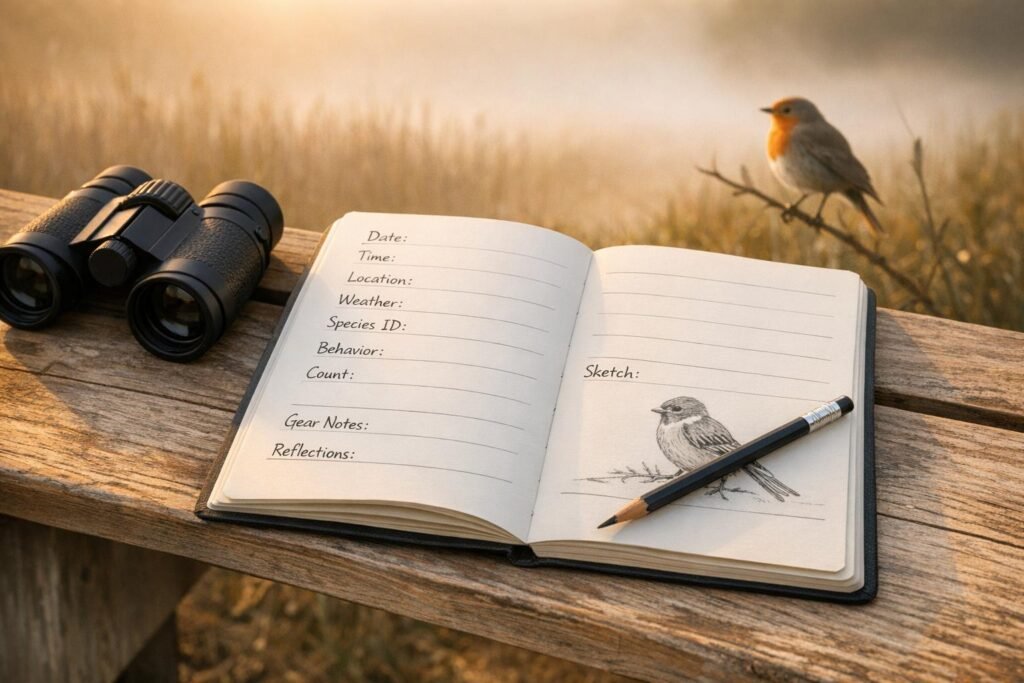
Birdwatching journals help you observe birds more closely, improve your identification skills, and contribute to conservation efforts. Here’s what to record:
- Date and Time: Note the exact date, time, and duration of your birding session. This helps track patterns like migration or activity times.
- Location and Habitat: Be specific about where you are, including landmarks and vegetation type. GPS coordinates or detailed notes about the surroundings can be helpful.
- Weather Conditions: Record temperature, wind, cloud cover, and precipitation. These factors often influence bird behavior.
- Species Identification: Write both the common and scientific names, along with key features like plumage, beak shape, or vocalizations. Include reasons for ruling out similar species.
- Behavioral Notes: Document what the bird was doing – feeding, nesting, flying, etc. Social interactions and foraging techniques add depth to your notes.
- Number of Birds: Count individuals or estimate flock sizes, and describe group dynamics, like cooperative behavior or dominance.
- Visuals and Tools: Add sketches, quick drawings, or photos. Note the equipment and apps you used, such as binoculars or bird ID apps, and how they performed.
- Personal Reflections: Include your thoughts, questions, and observations beyond the birds themselves. Reflect on the experience to make your journal more engaging.
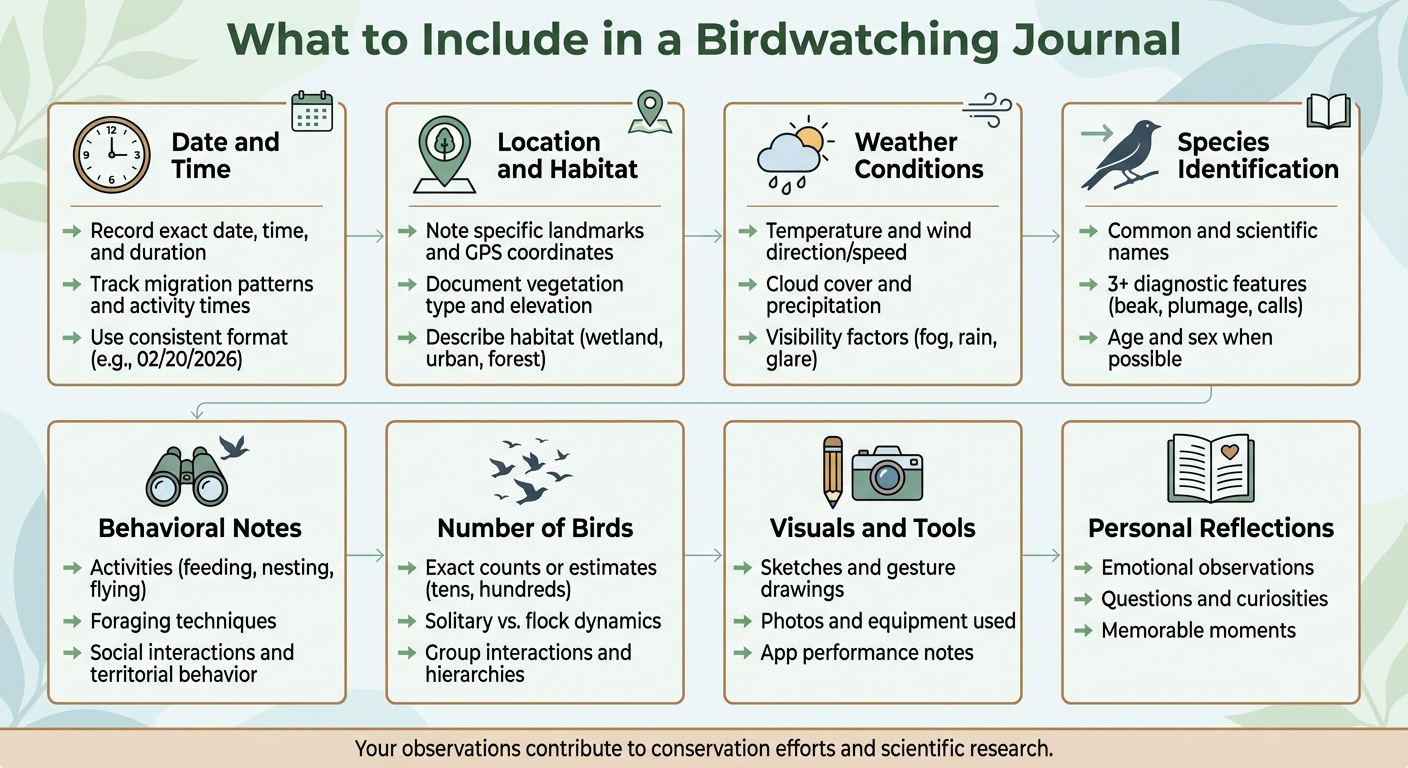
Essential Elements to Record in Your Birdwatching Journal
Birder’s Field Journal Pro Tips with John Muir Laws and Fiona Gillogly
sbb-itb-5a98267
Key Details to Record in Your Birdwatching Journal
Crafting a thorough birdwatching journal entry starts with three key elements that turn your observations into meaningful records. These details not only help you uncover patterns but also allow you to contribute to research and relive unforgettable moments in the future.
Date and Time
Noting the exact date and time of your sightings is essential for identifying trends. Be sure to include the day, month, year, and time of each observation. This can reveal fascinating patterns, like when specific species migrate or when they are most active. For instance, you might notice that chickadees frequent your feeder between 7:00 AM and 8:30 AM or that a certain warbler species reliably appears during the second week of May.
Make a habit of recording the start and end times for each birding session separately from travel time. The Cornell Lab of Ornithology advises:
"Keep track of the starting time at each location. Try to add the ending time at each, keeping track of travel time separate from birding time".
This level of detail is especially important if you’re sharing data with platforms like eBird, where timing helps researchers verify unusual sightings and analyze behavioral patterns. Stick to a consistent date format, like 02/20/2026, to ensure clarity when revisiting older entries.
Once you’ve recorded the timing, the next step is to capture location and habitat details.
Location and Habitat Information
Precise location details are crucial for confirming sightings and aiding future observations. Instead of simply writing "Central Park", note specific landmarks, such as a trail marker or even a unique tree. As eBird reviewer Lauren Harter explains:
"Some birds are very particular about their habitat, and it may be difficult to infer from the sighting location what the exact habitat was like".
For example, spotting a warbler in an oak forest at 1,200 feet elevation is very different from finding one in riverside willows at 300 feet.
Include notes about the surrounding vegetation, as plants often influence bird activity. Mention whether you’re in a wetland, urban area, or mixed forest, and note any nearby water sources. Many modern smartphones can embed GPS coordinates into photos, making it easier for others to locate rare species. The New York Breeding Bird Atlas highlights the value of detailed notes:
"Taking better notes also makes us better birders because we pay more attention to details in shape, plumage, habitat, and behavior, all of which are key factors when making an identification".
After documenting the location, it’s equally important to note the environmental conditions.
Weather and Environmental Conditions
Weather plays a significant role in bird behavior and visibility. Always record temperature, wind direction and speed, cloud cover, and any precipitation. For example, a 45°F morning with light northwest winds will likely offer different birding opportunities than a 72°F afternoon with gusty south winds.
Visibility is another critical factor. Fog, rain, or glaring sunlight can obscure key identifying features, making it harder to confirm what you’ve seen. These environmental notes not only help validate your sightings when shared with others but also provide context for why certain birds were easier – or harder – to spot on a particular day.
Documenting Bird Observations
After noting the time, location, and weather, it’s time to dive into the heart of your journal: documenting what you saw and how the birds behaved. With over 800 bird species found across the United States and more than 14.82 million active birders, keeping detailed records not only sharpens your identification skills but also contributes to a growing pool of valuable scientific data.
Species Identification
Start by recording both the common and scientific names of the bird, along with three key features that helped you identify it. These could include beak shape, plumage, or vocalizations. Lauren Harter, an eBird reviewer, suggests:
"A good rule of thumb is to try and include at least three independent, diagnostic features you saw or heard".
Pay special attention to vocalizations – whether it’s a melodic song or a distinct call note, sounds can be just as important as visual clues. Also, note the bird’s age and sex, as juveniles often have very different plumage from adults. If you ruled out similar species, include your reasoning. For example, explain why you identified a bird as a Glossy Ibis and not a White-faced Ibis – this adds credibility to your observations.
To assist with identification, you can use apps like Merlin Bird ID. Another handy trick is "digiscoping" – holding your smartphone up to your binocular lens to snap a quick photo for later reference. Once you’ve identified the bird, take some time to observe its behavior to complete your record.
Behavioral Notes
Adding behavioral observations turns a simple checklist into a rich, dynamic account. Note what the bird was doing – feeding, preening, nesting, flying, or even engaging in territorial disputes. Be specific about foraging techniques: was a woodpecker spiraling up a tree trunk, or was a hawk soaring in wide circles while scanning the ground? Instead of isolated actions, track movement sequences, like a chickadee hopping on a branch before darting to a feeder.
Social interactions are equally important. For example, in October 2013, ornithologist Steve N. G. Howell used detailed notes at Abbotts Lagoon, California, to document behaviors and age-related patterns. The American Birding Association highlights the value of this practice:
"Taking good field notes will improve your overall birding skills, as it requires you to look more closely at birds than you may have ever done before".
Unusual behaviors – like a robin bathing in a puddle during a rainstorm – can make your records even more meaningful. Developing a personal shorthand for common actions (e.g., symbols for "feeding" or "nesting") can also speed up your note-taking in the field.
Number of Birds and Group Dynamics
When documenting group sizes, use exact counts for smaller groups and estimates for larger flocks (e.g., "tens" or "hundreds"). Be clear about your counting method – for example, "exact count of 12 at the feeder" or "estimated 200+ flying overhead in waves."
Also, note whether the birds were solitary or part of a flock, and describe their interactions. Were they foraging cooperatively, or was there a dominant bird chasing others away? These observations can reveal social hierarchies and communication patterns. As identifybird.app explains:
"Your systematic documentation helps researchers track population trends, identify important habitats, and develop conservation strategies".
If you come across a mixed-species flock, list all the species present and describe how they moved together. For deeper insights, include demographic details, such as noting that a flock of 30 Cedar Waxwings consisted of roughly 20 adults and 10 juveniles. These details not only enrich your personal records but also contribute to larger scientific efforts when shared through platforms like eBird.
Adding Visuals and Tools to Your Journal
Sketches and Illustrations
Incorporating visuals into your journal not only enhances your written observations but also makes species records more memorable and detailed. Even simple hand-drawn sketches can boost your ability to recall details and improve your observation skills. One effective method is gesture drawing – quick, loose sketches that capture a bird’s overall shape, posture, and movement as it shifts positions. Liz Clayton Fuller, a Science Illustrator at the Cornell Lab of Ornithology, describes it well:
"The intention behind gesture drawing is to capture the essence of your subject – its behaviors, movements, and posture".
Pay attention to anatomical details that are key for identification, such as beak shapes, leg structures, and wing patterns. Label colors directly on your sketches, focusing on features like the bill, eyes, legs, and feet – details that often help narrow down species. You can also depict behavioral sequences by creating a series of simple drawings that show actions like hopping, preening, or feeding. To get the best results, spend about 15 to 20 minutes in a "sit spot." Staying still allows birds to return to their natural behaviors, giving you a better chance to observe them closely.
Your sketches can be further enriched by including notes on how your equipment performed during your observations.
Equipment and Apps Used
After capturing visual details, document the tools and gear you used to complete your field notes. This helps you evaluate their performance and make informed decisions for future outings. Include details about your binoculars, spotting scopes, or camera gear, noting specific settings or how they performed. For instance, you might record that your 8×42 binoculars provided sharp views at 50 feet but struggled in low-light conditions. These notes help you understand your equipment’s strengths and limitations.
Digital tools are just as important. Record how apps like Merlin Bird ID supported your observations, but avoid rehashing instructions already covered in earlier sections. Smart devices like FeatherSnap can capture real-time photos or videos, which you can later add to your digital journal for a storytelling touch. When combining physical and digital journaling, jot down reminders next to a bird’s name to review any related digital photos later. Don’t forget to evaluate your field tools, like pencils, and note how well they performed in different conditions. These small details can make a big difference in refining your journaling process.
Adding Personal Reflections and Insights
Once you’ve recorded detailed observations, take your birding journal to the next level by weaving in your personal reflections. Add emotional layers to your entries – capture moments of surprise, humor, or curiosity. These touches turn routine notes into a vibrant narrative that feels uniquely yours.
Naturalist and author John Muir Laws captures this perfectly:
"Journaling helps you find new aspects of things you have seen a thousand times before. Ultimately, it is not where you look, but how you look."
To bring more depth to your reflections, consider using prompts like "I notice…", "I wonder…", and "It reminds me of…". These simple phrases encourage you to move past just identifying species and instead explore your curiosity. For instance, you might jot down, "I wonder why the cardinal always shows up 10 minutes after the blue jays leave," or, "It reminds me of the territorial standoff I saw last spring." These musings add personality to your journal and help you stay engaged.
Don’t just focus on birds – embrace the unexpected. Document the finer details of nature: a stray feather, a hidden nest, or an unusual interaction. Include notes about who joined you on your outing or any memorable social dynamics you observed, like a bird defending its territory. These elements bring your ecosystem to life on the page. Some birders even name their frequent visitors, tracking their quirks – like a robin that bathes at exactly 7:30 a.m. or a one-legged crow with a bold personality.
Think of your journal as a message to your future self. Use metaphors to describe bird calls or behaviors and jot down your theories when something unusual happens. Whether you’re channeling a scientist, a poet, or simply noting that a blue jay scolded a squirrel during your morning coffee, your entries reflect your unique perspective. These reflections don’t just document your birding adventures – they deepen your bond with nature and make every outing more meaningful.
Conclusion
A birdwatching journal transforms casual observations into meaningful experiences. By jotting down details like the date, time, location, weather, species, and behaviors, you sharpen your observation skills and start to see patterns you might otherwise miss. As the Cornell Lab of Ornithology explains:
"Keeping a field notebook can help birders improve their birding skills, make their observations more valuable for themselves and for science, and provide a treasure trove that elicits powerful memories for decades."
Your journal doesn’t need to be flawless. Quick sketches, shorthand notes, or even personal musings are enough. Whether you’re describing a common robin or a rare migrant, this habit trains your eye to pick up on subtle details – like variations in plumage, unique behaviors, or seasonal changes. Over time, these entries form both a scientific record and a personal story of your growth as a birder. They also connect your individual experiences to larger conservation efforts.
If you’re just starting out, keep it simple. Begin with the basics, such as the date and location, and gradually include more detailed observations and reflections. Whether you prefer a pocket-sized notebook or a digital app, the key is consistency. Your future self will cherish the memories, and your present self will enjoy the mindfulness and deeper connection to nature that journaling brings to every outing.
For more tips on birdwatching and outdoor adventures, check out Adventurism.co.
FAQs
How detailed should my bird journal entries be?
When keeping a birdwatching journal, aim to include enough details to sharpen your observation skills. Be sure to note the date, time, and location of your sightings, along with the weather conditions. Record observations about the bird’s appearance, such as plumage colors, size, and distinguishing features. Document its behavior – what was it doing? Was it feeding, flying, or perched? Don’t forget to describe its calls or songs, as these can be key to identification.
For added depth, include details about the bird’s habitat and surroundings. If you’re artistically inclined, sketching the bird can help you highlight its unique traits. While the amount of detail is up to you, more thorough entries will make it easier to spot patterns and improve your identification skills over time.
What if I’m not sure of the species I saw?
When you’re unsure of a bird’s species, jot down as many details as you can for later identification. Include specifics like the date, location, time of day, and weather conditions. Pay attention to key features such as the bird’s size, color, markings, and behavior. Taking photos or audio recordings can also be incredibly helpful. These notes and visuals will make it simpler to compare with field guides or seek advice from experts, even if you can’t identify the bird immediately.
Should I use a notebook or a phone app?
Both notebooks and phone apps bring their own perks to birdwatching journaling. A notebook gives you a hands-on way to sketch and jot down notes, making the experience more personal and reflective. On the other hand, apps come packed with tools like location tagging, photo uploads, and streamlined organization. Your choice boils down to what suits you best, but blending the two can work wonders – enjoy the charm of handwriting while using tech for precise record-keeping.