

How long will your hike take? Estimating trail time is crucial for safety, energy management, and planning. Naismith’s Rule is one of the simplest ways to predict hiking duration:
- 1 hour for every 3 miles of distance
- + 1 hour for every 2,000 feet of elevation gain
It’s ideal for moderate terrain and average fitness levels but has limits, like ignoring downhill travel or group pace variations. Other methods, like Tranter’s Corrections, Tobler’s Hiking Function, and GPS-based tools, offer more tailored or precise estimates. Each method suits different terrains, fitness levels, and goals. Here’s how they compare:
| Method | Pros | Cons |
|---|---|---|
| Naismith’s Rule | Simple, quick to calculate | Doesn’t account for descent or personal pace |
| Tobler’s Function | Accurate for slopes | Requires tools like apps or calculators |
| Tranter’s Corrections | Adjusts for fitness and fatigue | Complex; fitness test needed |
| Book Time | Beginner-friendly, cautious estimates | Too slow for experienced hikers |
Choose the method that fits your trail and fitness level, and refine your estimates by tracking your pace over time.
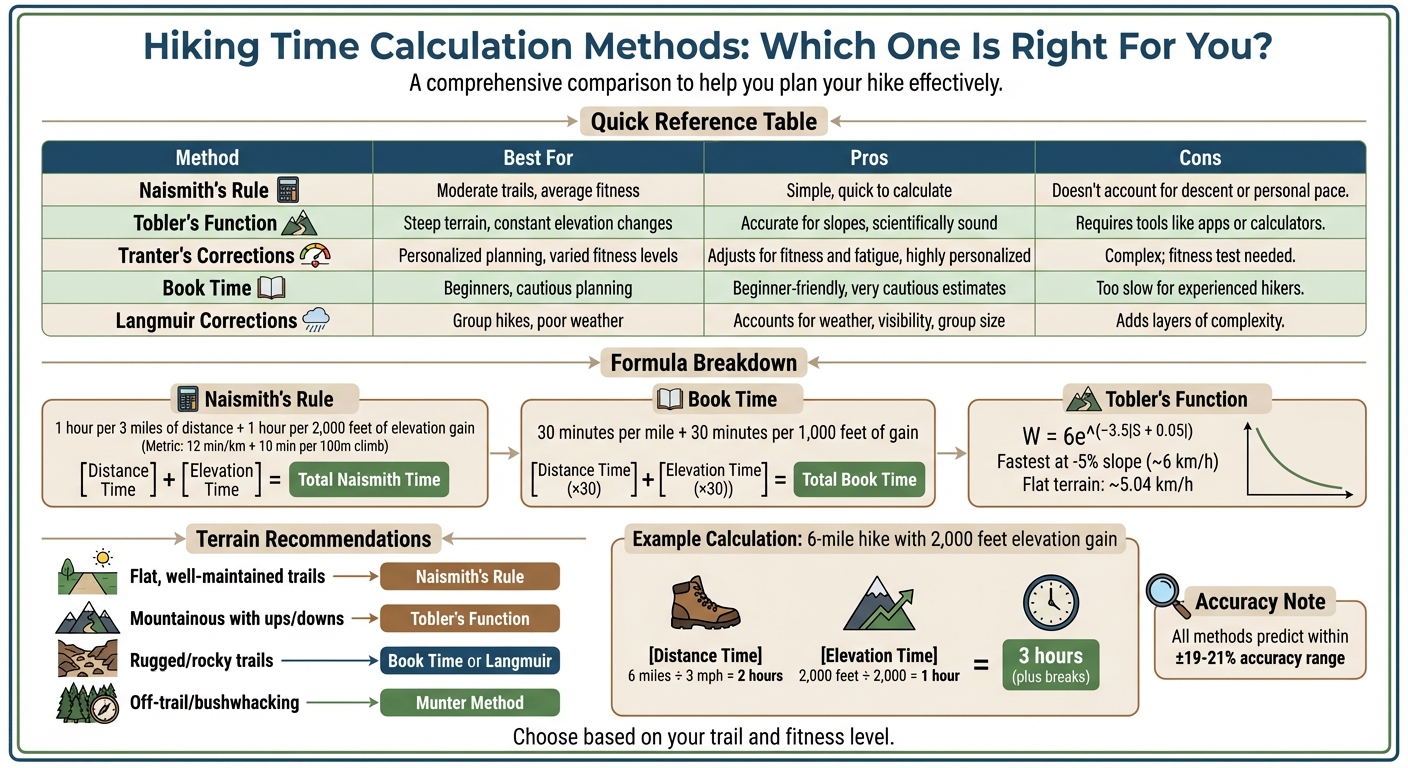
Hiking Time Calculation Methods Comparison Chart
How to calculate hiking time, book time and march time – LandNav Series Part 7
sbb-itb-5a98267
How Naismith’s Rule Works
Let’s break down how Naismith’s Rule functions and where it fits best in hiking scenarios.
The Basic Formula
At its core, Naismith’s Rule is simple: plan for 1 hour of hiking for every 3 miles of distance, plus 1 additional hour for every 2,000 feet of elevation gain. If you’re using metric measurements, this translates to 12 minutes per kilometer, with an extra 10 minutes added for every 100 meters of climbing.
To calculate the total hiking time, divide the horizontal distance by 3 mph (or 5 km/h) to get the time for flat terrain, then add the time for the ascent. For instance, a 6-mile hike with 2,000 feet of elevation gain would take 2 hours for the distance and 1 hour for the climb – a total of 3 hours. This doesn’t include breaks, so you’d need to tack on 15–30 minutes for each significant rest or photo stop.
One key insight from this formula is the concept of "Scarf’s Equivalence", which equates 3 miles of flat distance to the time it takes to climb 2,000 feet. This roughly 8:1 ratio illustrates why steep climbs often feel far more demanding than level terrain.
Where Naismith’s Rule Works Well
Naismith’s Rule is particularly effective for well-maintained trails with moderate terrain, such as Class 1 hikes on the Yosemite Decimal System that don’t involve scrambling or technical challenges. It’s most accurate for hikers with average fitness levels, especially on outings lasting 6 to 8 hours or less.
It works best under typical trail conditions: dry paths, moderate weather, and slopes that are neither extremely steep nor completely flat. Considering it was devised over 130 years ago, it’s impressive how well it still holds up for many scenarios.
However, the formula does have its limitations, especially when the terrain gets more challenging.
Where Naismith’s Rule Falls Short
The original formula doesn’t account for downhill travel. Steep descents, especially on rocky or loose surfaces, can take as much time – or even more – than climbing. To address this, many experienced hikers add 10 minutes for every 1,000 feet of descent on tricky trails.
Another limitation is that it assumes a steady pace for a fit hiker, which doesn’t reflect reality for most people. Factors like heavy backpacks, high altitudes, rough terrain, or bad weather can slow you down significantly, adding up to 15% more time to your estimate. Additionally, after about 12 miles, fatigue sets in, naturally slowing your pace – something the formula doesn’t account for.
For group hikes, it’s always wise to calculate based on the slowest member’s pace. And if you find that your actual times consistently differ from Naismith’s predictions, track your results over a few hikes to develop a personal adjustment factor. For example, newer hikers might use a multiplier of 1.15x, while more experienced or fit individuals could go with 0.9x.
Next, we’ll see how Naismith’s Rule compares to other methods for estimating hiking times.
Other Hiking Time Calculation Methods
While Naismith’s Rule offers a straightforward way to estimate hiking time, there are other methods that cater to different terrains, fitness levels, and precision needs.
Tranter’s Corrections
Tranter’s Corrections refine Naismith’s Rule by factoring in individual fitness. Instead of assuming a uniform hiking pace, this method starts with a simple test: time yourself climbing 1,000 feet over a 0.5-mile stretch. Based on your result, you’ll fall into a fitness category. For example, a "Very Fit" hiker who completes the test in 15 minutes might finish a hike about 8% faster than Naismith’s baseline. In contrast, a "Novice" hiker taking 30–35 minutes could need roughly 12% more time.
To put this into perspective, on a 20-mile hike with an 8,500-foot elevation gain, the difference in fitness levels might result in nearly a 50-minute variation in estimated time. Tranter’s method also adjusts for fatigue on longer hikes. Carrying a heavy pack (around 45 pounds or 20 kg)? Drop down one fitness level to reflect the added effort.
Now, let’s look at a method that focuses on the impact of slope on hiking speed.
Tobler’s Hiking Function
Tobler’s Hiking Function takes a different approach by using an exponential formula to calculate walking speed based on slope angle. The formula,
W = 6e^(-3.5|S + 0.05|),
(where S is the gradient), reveals that hikers move fastest on a gentle downhill slope of about –5%, reaching speeds near 6 km/h. On flat terrain, the function predicts a speed of roughly 5.04 km/h, aligning closely with Naismith’s assumptions. However, steeper slopes – uphill or downhill – noticeably slow your pace. This makes Tobler’s method especially useful for trails with constant elevation changes. That said, its complexity often requires a calculator or app for practical use.
GPS-Based Calculators and Apps
Modern tools combine these traditional methods with advanced technology to fine-tune hiking time estimates. Apps like HikeClock and TrailsNH integrate models such as Naismith’s Rule, Tobler’s Function, and Tranter’s Corrections into a single calculation. These tools use high-resolution Digital Elevation Models to analyze your route and factor in variables like fitness level, age, pack weight, and even weather conditions. Some apps can also warn you if you’re at risk of finishing after sunset.
As HikeClock explains:
These calculations provide estimates based on mathematical models and should be used for planning purposes only. Actual hiking times vary significantly based on individual fitness, weather conditions, trail conditions, group dynamics, and many other factors.
The accuracy of these tools depends on the quality of elevation data and the reliability of the information you provide.
Comparing Naismith’s Rule to Other Methods
Pros and Cons of Each Method
When it comes to estimating hiking times, each method has its strengths and weaknesses. Naismith’s Rule stands out for its simplicity – you can calculate times in your head. However, it assumes average fitness levels and doesn’t account for slowdowns on steep descents. Tobler’s Hiking Function is more precise, modeling how pace changes with varying slopes, but it usually requires a calculator or app. Tranter’s Corrections are great for tailoring estimates to individual fitness, showing up to a 50-minute difference between a seasoned hiker and a beginner on a 10-mile trail. On the other hand, Book Time offers a more cautious approach, which might frustrate experienced hikers due to its conservative estimates.
Here’s a quick comparison:
| Method | Pros | Cons |
|---|---|---|
| Naismith’s Rule | Easy to calculate; widely recognized | Ignores descent; assumes average fitness; overly optimistic |
| Tobler’s Function | Scientifically sound; accurate for steep terrain | Requires tools like calculators or apps; needs detailed elevation data |
| Tranter’s Corrections | Adjusts for fitness and fatigue; highly personalized | Complex calculations; requires knowledge of fitness level |
| Book Time | Beginner-friendly; very cautious | Too slow for fit hikers; doesn’t adjust for descent |
| Langmuir Corrections | Accounts for weather, visibility, and descent errors | Adds layers of complexity to basic formulas |
Studies suggest that these methods generally predict hiking times with an accuracy range of ±19–21%. So, whichever method you choose, your actual time will likely fall within that margin.
Which Method Works Best for Different Terrain
The terrain plays a huge role in determining which method works best. For flat, well-maintained trails, Naismith’s Rule performs well. Its 3 mph baseline is a solid estimate when there’s little to no elevation change. But when the trail becomes mountainous with constant ups and downs, Tobler’s Function shines. It accurately captures the slowdown on steep ascents and even accounts for slight speed gains on gentle descents.
On rugged or rocky trails, Book Time or Langmuir Corrections are better choices. These methods factor in slower speeds caused by poor footing and steep descents (especially over 12°). For off-trail scenarios like bushwhacking, the Munter Method comes in handy, using specific multipliers to account for the challenges of untracked terrain.
These terrain-specific recommendations highlight how the right method can make a big difference depending on the trail conditions.
How Each Method Handles Individual Differences
When it comes to individual differences, some methods are better equipped than others. Naismith’s Rule and Tobler’s Function assume an average hiker and don’t adjust for fitness or load. In contrast, Tranter’s Corrections take a more personalized approach. This method suggests a simple fitness test – timing how long it takes to climb 1,000 feet over half a mile. A fit hiker completing the test in 15 minutes can reduce their estimated time by 8%, while a beginner taking 30–35 minutes might see a 12% increase. It also accounts for pack weight, lowering your fitness category by one level for every 44 pounds carried.
Langmuir Corrections go a step further by factoring in group dynamics. For groups larger than four, it adds 5% to the estimated time for each additional person. It also adjusts for unfamiliar terrain and poor visibility. For hikes exceeding 20 miles, Tranter’s Corrections add 10–25% to account for fatigue.
Each method handles individual and group variations differently, offering flexibility for hikers to choose what suits their needs best.
Conclusion
Main Differences Between Methods
The core distinction lies in simplicity versus precision. Naismith’s Rule is favored for its straightforward approach – you can calculate hiking times mentally using 3 mph plus 30 minutes per 1,000 feet of ascent. On the other hand, Book Time takes a more cautious stance with its formula (30 minutes per mile plus 30 minutes per 1,000 feet of gain), making it ideal for beginners or challenging terrain like the White Mountains. Tobler’s Hiking Function brings mathematical accuracy into the equation, factoring in the effects of slope angles on speed, such as the faster pace on a gentle -5% downhill slope. Meanwhile, Langmuir and Tranter’s Corrections introduce a personalized touch by adjusting for fitness levels, fatigue on longer hikes, and external conditions like fog or wind.
How to Choose the Right Method
The best method depends on your experience and the trail conditions. If you’re new to hiking or traveling with a group, Book Time offers a safe and conservative estimate. For moderate, well-maintained trails, Naismith’s Rule is a quick and practical choice. When tackling rugged terrain with steep ascents and descents, Tobler’s Function often provides the most accurate predictions. To fine-tune your planning, log 5–10 hikes to identify your personal pace – if you’re consistently slower than Naismith’s estimate, adjust future calculations by multiplying by 1.1. Alternatively, you can combine methods by using Book Time for a worst-case scenario and Naismith for an expected timeframe, giving you a realistic planning window.
Once you’ve selected your method, focus on practical strategies for applying it effectively.
Next Steps for Hikers
Refine your estimates through real-world testing. Track your actual hiking times and compare them to the predictions from different methods to find the one that matches your pace best. Don’t forget to factor in an additional 25% for breaks, photo stops, and navigation – these "faff" moments can quickly add up. For safety, always set a hard turnaround time by working backward from sunset, using your most conservative estimate. For further guidance, Adventurism.co offers resources on trail navigation and preparation to help you plan safer, more enjoyable hikes. As HikeClock wisely states:
Your personal experience is the best calibration tool.
FAQs
How do I adjust Naismith’s Rule for steep descents?
When applying Naismith’s Rule to steep descents, it’s important to factor in the slope’s angle. Gentle slopes (less than 5°) can actually save you time, allowing you to subtract about 10 minutes for every 1,000 feet descended. Moderate to steep slopes (5-12°) tend to slow you down, so you should add roughly 10 minutes per 1,000 feet. For very steep descents, the difficulty and risk increase significantly, requiring extra time and caution. These adjustments are critical to ensure your hiking time estimates remain accurate.
Which method is best for rugged or rocky trails?
For trails that are rugged or rocky, Tobler’s Hiking Function offers more precise time estimates compared to Naismith’s Rule. This method takes into account both slope and the complexity of the terrain, making it particularly useful for challenging environments. Researchers like Langmuir and Tranter have introduced advanced corrections to further refine these calculations, addressing factors like the added difficulty of descents and the effects of fatigue. These approaches provide a more realistic measure of hiking time, especially for steep or technical trails where simpler rules often fall short.
How can I calibrate a time estimate to my own pace?
To figure out how long a hike might take at your pace, start by tracking your speed on different types of terrain and under various conditions. Keep a record of how much time you need to cover specific distances and elevation gains. Once you have a good sense of your average pace, you can use it with tools like Naismith’s Rule – just make adjustments for tougher terrain or steeper climbs. This tailored method gives you a more accurate estimate based on your actual hiking performance.