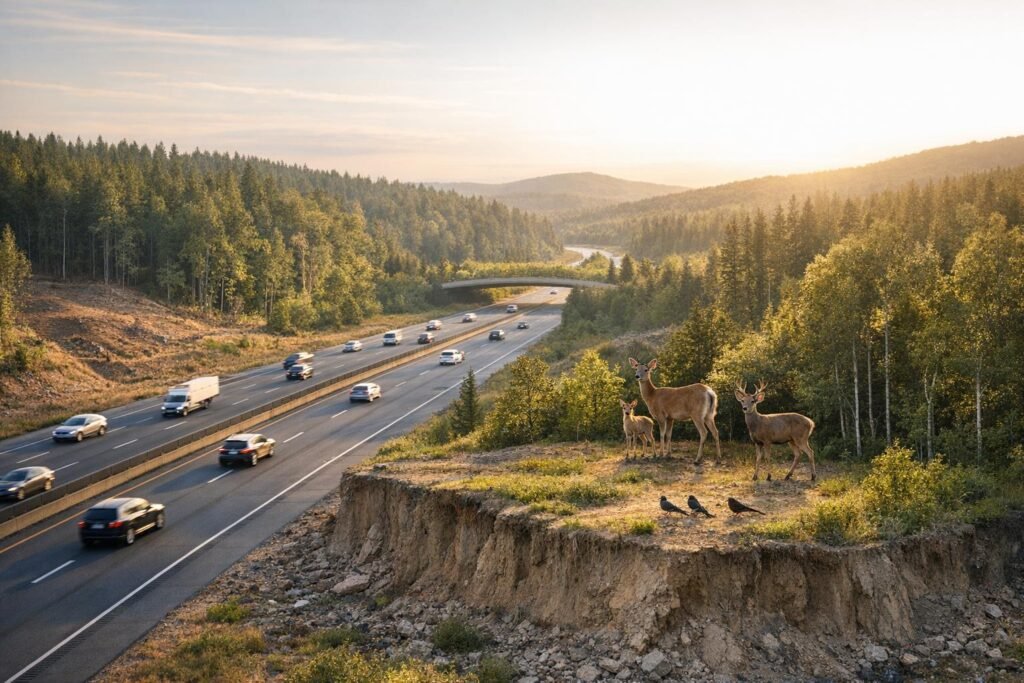
When large habitats are broken into smaller, isolated patches by roads, farms, and cities, wildlife struggles to survive. This is habitat fragmentation, and it disrupts ecosystems by reducing biodiversity, isolating animal populations, and limiting access to resources like food and water. Over 70% of forests globally are now within 0.6 miles of human-altered edges, making species more vulnerable to predators, climate changes, and human interference.
Key Takeaways:
- Biodiversity Loss: Fragmentation reduces species diversity by up to 75%.
- Resource Scarcity: Animals face barriers like highways, blocking access to food, water, and mates.
- Genetic Isolation: Small, isolated populations suffer from inbreeding and reduced adaptability.
- Human-Wildlife Conflict: Shrinking habitats push animals toward human areas, causing collisions, crop damage, and safety risks.
Solutions:
- Wildlife Corridors: Bridges and underpasses reconnect habitats, reducing animal-vehicle collisions by up to 90%.
- Habitat Restoration: Replanting native vegetation and removing barriers helps rebuild ecosystems.
- Policy Support: Conservation laws and community involvement protect migration routes and natural spaces.
Habitat fragmentation is a global challenge, but targeted conservation efforts can help reconnect ecosystems and protect wildlife for the future.
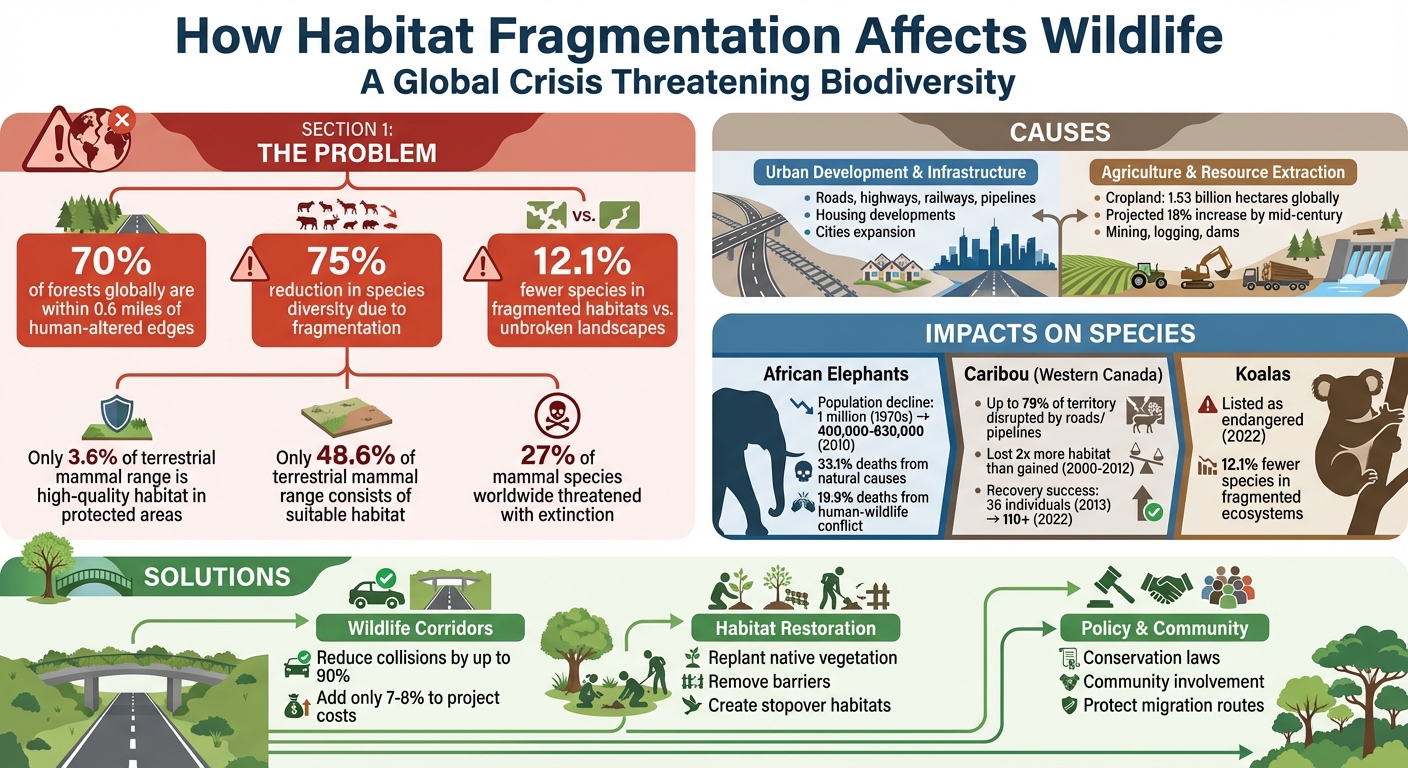
Habitat Fragmentation Impact on Wildlife: Key Statistics and Solutions
How Does Habitat Fragmentation Affect Biodiversity? | Explaining Ecology News
What Causes Habitat Fragmentation
Habitat fragmentation is largely driven by human activities, with urban development and agriculture combined with resource extraction being the primary culprits.
Urban Development and Infrastructure
Roads, highways, railways, and pipelines carve through once-continuous landscapes, breaking large habitats into smaller, disconnected pieces. These structures not only occupy valuable space but also block wildlife from accessing critical resources. As cities grow, housing developments consume natural land, creating a mosaic of human-altered zones that isolate remaining wildlife areas. This compounds the barrier effects, making it harder for species to thrive.
Fragmented habitats are less biodiverse, containing 12.1% fewer species compared to unbroken landscapes. For terrestrial mammals, only 3.6% of their range consists of high-quality habitats within protected areas. These barriers also amplify edge effects – areas at habitat boundaries experience more wind, sunlight, and noise. On top of that, infrastructure can act as a gateway for invasive species, allowing them to infiltrate previously untouched regions.
Urban expansion isn’t the only factor. Farming and resource extraction also play a major role in fragmenting habitats.
Agriculture and Resource Extraction
Agriculture reshapes forests and grasslands into cropland and pastures, leaving behind isolated patches of natural habitat. Similarly, mining and oil exploration cut through ecosystems, destroying core habitats. Logging creates "perforated" forests, where edges dominate over interior spaces, and dams disrupt river systems, blocking migration routes for aquatic species.
Currently, global cropland spans 1.53 billion hectares, with projections suggesting an 18% increase by mid-century. The Brazilian Atlantic Forest is a stark example of this impact. Historically, 90% of the forest lay more than 0.6 miles from an edge, but today, that figure has dropped to less than 9%. These activities don’t just fragment habitats – they disrupt essential ecological processes like seed dispersal, pollination, and nutrient cycling.
How Habitat Fragmentation Affects Wildlife
When habitats are divided into smaller sections, wildlife face significant challenges in their struggle for survival. These disruptions not only limit access to critical resources but also reduce genetic diversity, pushing many species toward population decline.
Limited Access to Resources
Physical barriers like highways, railways, and dams often block wildlife from reaching food and water, leaving them at risk of starvation and dehydration. Fragmentation also shrinks the "core" areas of habitats – those stable, interior zones that many species depend on. Instead, animals are forced into edge zones, which are less secure and often lack sufficient food and shelter.
These edge zones come with additional challenges. Changes in microclimates, such as increased sunlight and dryness, make it harder for plants and animals to thrive. Predators are also more common in these areas, adding another layer of risk. For migratory species like caribou and elephants, disrupted routes lead to competition over dwindling resources.
"Most forests are well within the range where human activities, altered microclimate, and nonforest species may influence and degrade forest ecosystems." – Science Advances
Currently, only 48.6% of a terrestrial mammal’s geographic range consists of suitable habitat, and a mere 3.6% of that range falls within protected areas. This reduction in habitat not only limits access to resources but also isolates populations, increasing the risk of genetic decline.
Loss of Genetic Diversity and Inbreeding
Fragmented habitats don’t just restrict movement; they also disrupt gene flow. When populations are cut off from one another, genetic diversity suffers. Isolated groups experience genetic drift, where beneficial traits are lost, and limited mate options lead to inbreeding.
The effects can be devastating. Fragmented landscapes often lose over 20% of their species within a year, and more than 50% within a decade – a phenomenon known as "extinction debt". For example, research from the Biological Dynamics of Forest Fragments Project in the Amazon revealed that 1-hectare fragments lost half their bird species in just five years. Larger 100-hectare fragments took 12 years to experience the same decline. Tropical species are especially vulnerable, showing a sensitivity to fragmentation six times greater than species in higher-latitude regions.
One stark example is the Macquarie perch, an endangered fish in Australia. Small, isolated populations of this species are expected to face severe inbreeding within a few decades due to the lack of natural migration and genetic exchange. As genetic isolation worsens, many species are forced to encroach on human-dominated areas, leading to increased conflict.
More Human-Wildlife Conflict
As fragmented habitats fail to meet their needs, animals are increasingly drawn to human settlements in search of food and water. This often results in crop damage and livestock predation. With wildlife venturing closer to farms and cities, encounters with humans, vehicles, and domestic animals become unavoidable.
The consequences are harmful to both sides. Wildlife face dangers like vehicle collisions, attacks by dogs, and exposure to diseases. Humans, meanwhile, suffer economic losses from destroyed crops and livestock, as well as safety threats. For instance, Asian elephants confined to smaller areas frequently encounter blocked migration paths, leading to more conflicts with nearby communities. Similarly, koalas in fragmented Australian habitats face increased risks from vehicle strikes, dog attacks, and bushfires.
"Habitat fragmentation – one of the biggest threats to wildlife in every corner of the world where humans live." – IFAW
With 27% of mammal species worldwide now threatened with extinction, the clash between shrinking wildlife habitats and expanding human activity continues to grow.
sbb-itb-5a98267
Species Affected by Habitat Fragmentation
Habitat fragmentation is shrinking natural territories, leaving many iconic species struggling to survive. As previously mentioned, this phenomenon limits access to resources and reduces genetic diversity, creating severe challenges for wildlife. Let’s take a closer look at how specific species are impacted by fragmented habitats.
African Savannah Elephants
Elephant migration routes are increasingly blocked by roads, fences, and farmland, leading to a dramatic population decline – from roughly 1 million in the 1970s to an estimated 400,000–630,000 by 2010. Studies reveal that 94.5% of elephant sightings occur within 6.2 miles of a river, and 95.8% are on flat terrain with slopes under 3°. Infrastructure disrupting these preferred habitats isolates elephant populations, heightening risks of inbreeding and resource scarcity.
In Kenya, researchers documented 9,182 elephant deaths between 1992 and 2017. Of these, 33.1% were due to natural causes like drought and disease, while 19.9% resulted from human–elephant conflicts. Males, adult elephants, and those living outside protected areas faced the highest mortality rates. These statistics paint a stark picture of how human development is reshaping elephant survival.
Koalas in Australia
Koalas are particularly vulnerable to habitat fragmentation caused by urban expansion and land clearing. In February 2022, the Australian government listed koala populations in Queensland, New South Wales, and the Australian Capital Territory as endangered due to these pressures. Fragmented eucalyptus forests force koalas to traverse open areas, exposing them to threats like vehicle collisions and dog attacks. Without continuous tree cover, they struggle to find food or mates safely.
Bushfires add another layer of danger. In fragmented landscapes, koalas have fewer escape routes and limited places to take shelter. Research shows that fragmented ecosystems support 12.1% fewer species compared to connected natural areas. For koalas, whose diet depends exclusively on eucalyptus leaves, this loss of biodiversity makes survival even more precarious.
Caribou in North America
Caribou habitats across Western Canada have been severely impacted by forestry, oil and gas development, and expanding road networks. Between 2000 and 2012, caribou subpopulations in Alberta and British Columbia lost twice as much habitat as they gained. In some regions, up to 79% of caribou territory is disrupted by roads and pipelines. These "linear features" act as predator highways, enabling wolves and bears to hunt more effectively in areas that were once safe for caribou.
Logging further complicates the situation by creating early-growth forests that attract moose and deer, which in turn support larger predator populations. Meanwhile, lichens – the caribou’s critical winter food source – can take 80 to 100 years or more to recover after disturbance.
"Caribou in this area were once as abundant as ‘bugs on the landscape.’" – West Moberly First Nations
From 2013 to 2021, the West Moberly and Saulteau First Nations implemented a recovery program for the Klinse-Za caribou subpopulation in British Columbia. By combining wolf reduction efforts with maternity penning – where mothers and calves are protected in secure enclosures during critical weeks – they managed to grow the population from just 36 individuals in 2013 to over 110 by 2022. While this success is encouraging, experts caution that without long-term habitat restoration, these gains could be short-lived.
These examples illustrate how fragmented habitats are jeopardizing species survival across the globe, emphasizing the urgent need for conservation efforts.
Solutions to Reduce Habitat Fragmentation
Wildlife Corridors and Crossings
Wildlife corridors connect isolated habitats, allowing animals to move freely for feeding, mating, and seed dispersal. Engineered crossings, like overpasses and underpasses, create safe pathways across roads and other barriers. Studies show that well-placed crossings can lower animal-vehicle collisions by as much as 90%, while adding only 7–8% to project costs.
Some recent projects showcase the success of these strategies. For instance, the Wallis Annenberg Wildlife Crossing in Agoura Hills, California, set to be completed in early 2026, will become the largest wildlife crossing in the world, offering a vital connection for the region’s mountain lions. Similarly, the Robert L.B. Tobin Land Bridge in San Antonio, Texas, which opened in December 2020, currently holds the title of the largest wildlife bridge in the United States.
While these crossings provide immediate solutions, restoring natural habitats plays an equally important role in bridging fragmented ecosystems.
Habitat Restoration and Conservation
Reconnecting fragmented landscapes requires targeted habitat restoration. This involves reestablishing native plants in key areas to create corridors that resemble the original habitat. Focusing on historical connectivity ensures that these efforts improve the ecological health of the region.
Removing unnecessary roads, rehabilitating decommissioned pathways, and modifying or eliminating obstructive fences are practical steps to enhance connectivity. Large physical barriers can severely disrupt wildlife movement, but innovative solutions like virtual fencing can help animals move more freely.
Restoration efforts should also include "stopover" habitats – areas where animals can rest and find food during migration. For example, mule deer may spend up to 95% of their migration time in these zones. To make these efforts successful, partnerships and conservation easements that span property boundaries are crucial.
Policy and Community Involvement
Physical changes alone aren’t enough; policy reforms and community engagement are critical for maintaining habitat connectivity. Legislation like the Wildlife Corridors Conservation Act and financial tools such as conservation easements can help mitigate habitat fragmentation, reduce costly wildlife-vehicle collisions, and support local economies.
Local zoning restrictions and conservation overlays in land use plans can also protect migration corridors from urban sprawl and industrial development.
"Better alignment of land use rules and priorities among landowners and managers is essential to conserving the wildlife that transits public, Tribal, and private lands."
Communities can take action by retrofitting fences to be more wildlife-friendly and integrating connectivity-focused areas into local planning. Tribal governments are increasingly recognized for their role in managing critical migration routes, further emphasizing the importance of collaboration.
Conclusion
Habitat fragmentation is one of the most urgent threats facing wildlife today, pushing species closer to extinction and disrupting the ecosystems that sustain us all. When habitats are divided, critical processes like nutrient cycling and pollination are disrupted, while isolated animal populations lose genetic diversity, making it harder for them to adapt to challenges like climate change. As natural spaces shrink, animals are forced to venture into human areas in search of food and water, which leads to conflicts that endanger both wildlife and people.
Thankfully, there are actionable ways to address these issues. Even small changes in your own backyard can make a big difference. For instance, planting native trees, wildflowers, and grasses can provide food and shelter for wildlife. Swapping out solid fences for hedgerows or natural barriers creates pathways for animals, and something as simple as adding a bird bath or water bowl can help species struggling to find water during dry spells.
On a broader scale, supporting conservation programs can amplify these efforts. Initiatives like the International Fund for Animal Welfare’s Room to Roam program are working across 10 landscapes in East and Southern Africa to secure safe migration routes for 330,000 African savannah elephants. Similarly, the Wildlife Trust of India, in collaboration with IFAW, has spent over a decade protecting 101 elephant corridors, ensuring safer movement between fragmented habitats.
As lovers of the great outdoors, we all have a role to play in safeguarding the natural spaces we cherish. Whether you’re hiking through a forest or planting a garden at home, every thoughtful action helps reconnect fragmented habitats, giving wildlife a chance to thrive for generations to come. Together, we can help restore balance to our shared world.
FAQs
What is habitat fragmentation, and how does it harm wildlife?
Habitat fragmentation happens when vast, continuous ecosystems are broken up into smaller, isolated patches. This division has a profound effect on wildlife, shrinking the space available for species to live and thrive. It also introduces more habitat edges – areas where ecosystems meet human-altered landscapes – exposing animals to new dangers like invasive species, changing climates, and increased human activity. These pressures can shrink populations and hinder their ability to reproduce.
Fragmentation doesn’t just limit living space – it also disrupts movement. Animals often struggle to travel between these isolated patches, leading to reduced gene flow and a heightened risk of extinction. Species that require large, connected habitats or are highly sensitive to environmental changes face the greatest challenges. Over time, this isolation results in lower biodiversity, as only the hardiest species manage to adapt to these fragmented environments.
Beyond its impact on wildlife, habitat fragmentation can also interfere with essential ecosystem processes, such as nutrient cycling and biomass production. This environmental degradation accelerates the loss of species and weakens the overall health of ecosystems. Together, these cascading effects make habitat fragmentation one of the primary drivers of biodiversity decline.
How do wildlife corridors help reduce the effects of habitat fragmentation?
Wildlife corridors are natural routes that link separate habitats, giving animals and plants safe passage between areas. These pathways are essential for maintaining genetic diversity, preventing inbreeding, and reducing the risk of species loss in isolated populations. They also enable species to move freely, contributing to healthier and more balanced ecosystems over time.
Examples of these corridors include green overpasses built over highways and forested strips that connect larger habitat zones. Studies reveal that habitats with these connections see fewer extinctions, more successful species colonization, and greater biodiversity. By reconnecting landscapes fragmented by roads, farming, and urban development, wildlife corridors play a key role in protecting ecosystems and sustaining wildlife populations throughout the United States.
Why is genetic diversity crucial for wildlife in fragmented habitats?
Genetic diversity plays a crucial role in the survival of wildlife. It enables populations to adapt to shifting environments, fend off diseases, and maintain their overall well-being. However, in fragmented habitats where animal populations become isolated, this diversity often diminishes. The result? Inbreeding and an increased risk of extinction over time.
The solution lies in safeguarding and rebuilding habitat connectivity. By establishing wildlife corridors and minimizing habitat fragmentation, we give species the chance to flourish. This not only helps individual populations but also supports balanced, resilient ecosystems.