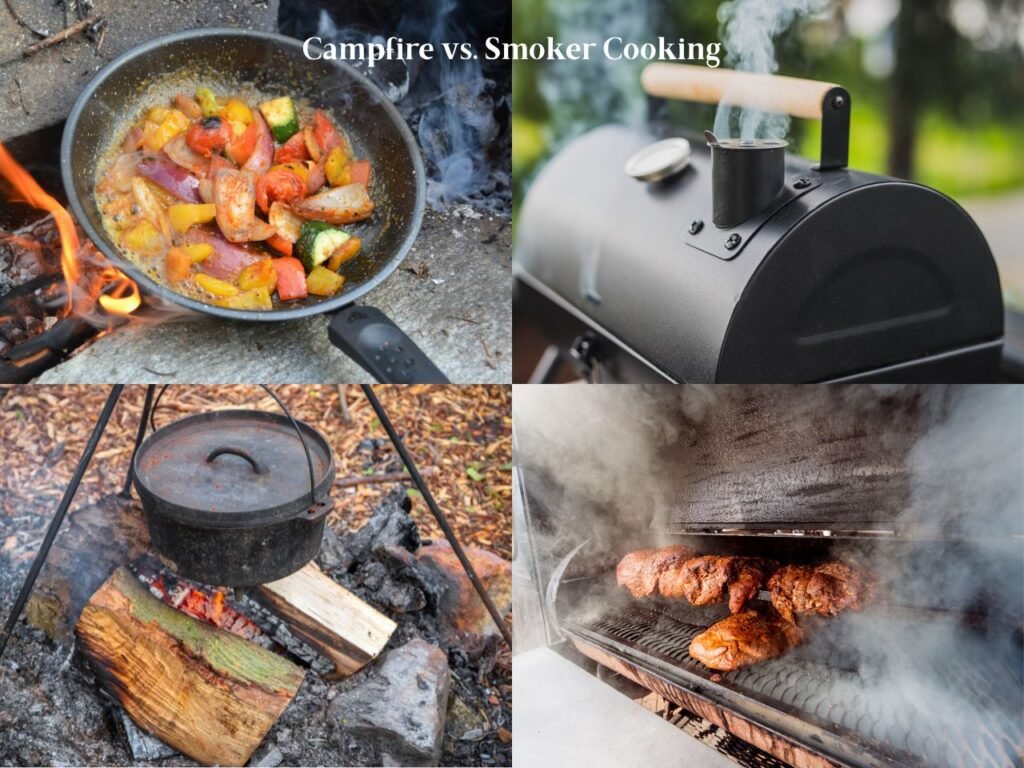
Cooking food is something most people learn out of necessity, and with the passage of both time and experience, some begin to peer behind the veil and see more than just simply sustenance. They can start unraveling the best ways to make their foods an experience for the palate and a pure delight to sample. Conversely, some people disdain cooking entirely and want the most basic method to get the job done, with speed being the name of the game. Thankfully enough, smokers allow you to pursue flavor and texture, whilst cooking over a campfire can be done in a flash (comparatively speaking, of course).
What Are the Differences Between Campfire and Smoker Cooking?
The most significant difference between a campfire-cooking experience and one achieved with a smoker usually boils down to the overall time it takes to make the food. After that, you can delve into separate categories that let you further break down which one might be better for you than the other, assuming time wasn’t the deciding factor.
A campfire can provide ambient heat for an entire area to begin with. You start with something that offers a cooking method and utility for your camp or the area where you are resting. Depending on how equipped you are, you can use skewers to roast portions of meat and veggies and make kebabs. You can also have a metal grate over the fire to simulate a grilling experience.
Alternatively, a smoker allows you to take your time, and focus more on the activities you are doing outside of cooking, due to the food being safely nestled inside the smoker itself, absorbing wonderful charred flavors, smoky aromas, and getting tenderness that just cannot be achieved over a fire without perhaps extensively marinating the food beforehand.
How Do Campfires Work?
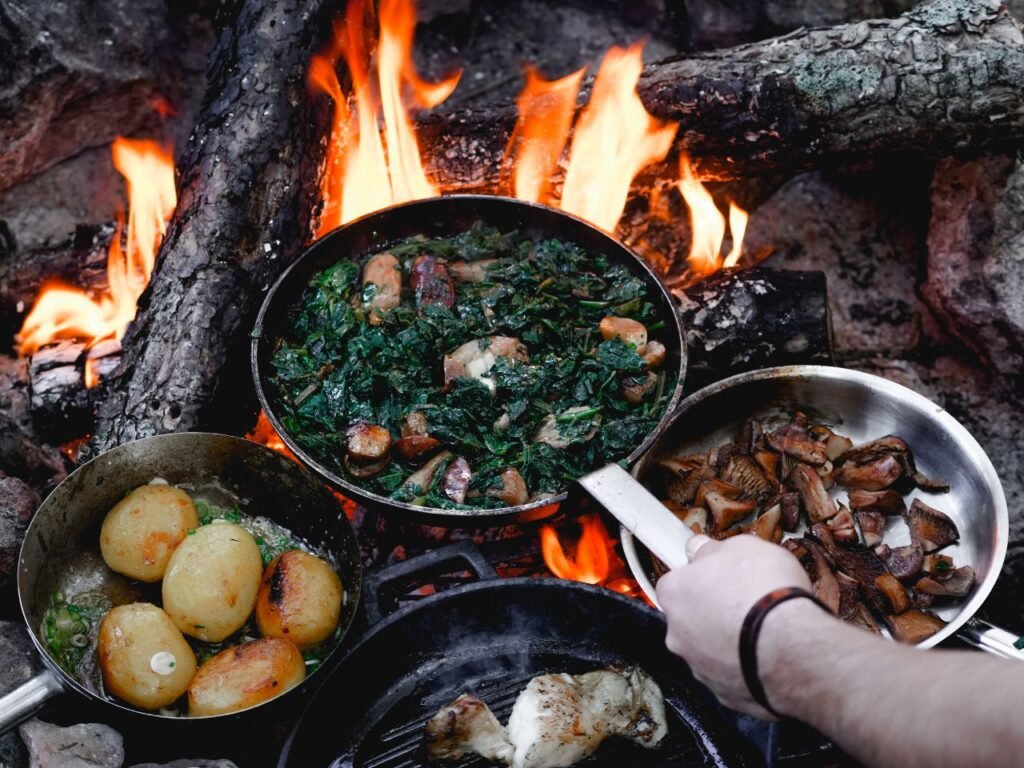
A campfire “works” by having a dug-out pit or a safely elevated pile of wood, kindling, or charcoal placed in the open, and ignited, with the raw power of the fire itself allowing you to sear anything you wish to eat at your leisure. You can add layers of complexity to your campfire by using different kinds of wood and other additional luxuries around it, but the base idea remains the same.
Advantages of Campfires
One of the biggest boons you obtain using a campfire is the raw heating element that it provides in the area where it’s started. During colder weather, this can prove invaluable; during warmer weather, the smoke itself can deter bugs and other pests from getting too close to the area, making your experience more enjoyable by association.
As for cooking, campfires can get you fed in minutes, assuming you brought food that roasts quickly and easily. Things like hot dogs, chunks of meat, sliced veggies, and more are simple ways to stave off hunger. Still, you can definitely set up a small grilling station over a fire pit, or use the ever-popular “spit,” a metal rod elevated over the fire, typically with a large piece of meat in the center, that you slowly rotate to cook whatever you like.
You’ll also only need the raw tools required to start the campfire, unless you plan on making the aforementioned elaborate fire pit. Even a simple lighter (or good ol’ scout tactics) can get a fire going almost anywhere, meaning you need to pack far less to get your food situation taken care of.
Disadvantages of Campfires
Campfires, while easy to make, have some complications that can arise when used. For starters, it is a raw, pseudo-uncontrolled fire that rages until you extinguish it, so it isn’t precisely the safest cooking method you can use. More importantly, if you have young children or pets, they can accidentally stumble into the fire, creating a scene of pure chaos. Even if you take the time to set up preventive measures, it is still possible.
Cooking with a campfire also limits you to what kinds of foods you’ll be able to cook reliably, and definitely leans more towards having a charred texture on almost any food you do make. You can use foil wraps and other methods to mitigate this somewhat, but the overall taste will remain the same, with very little flexibility from the fire itself. (Obviously, everyone can season their own food however they like, but in this context, we are speaking directly towards the fire’s direct contribution to the food and flavor of it.)
Ending things on a safety note, campfires are a fire hazard, so they need to be fully extinguished. The area is carefully examined after you are done cooking to guarantee you don’t accidentally start a wildfire, or the fire re-ignites itself even in a contained setting. At the same time, you are asleep. While not difficult with some training, knowing when a fire is completely out without drenching the entire area can be very hard to gauge, but is mandatory to ensure the safety of yourself, your friends and family, and finally nature.
How Do Smokers Work?
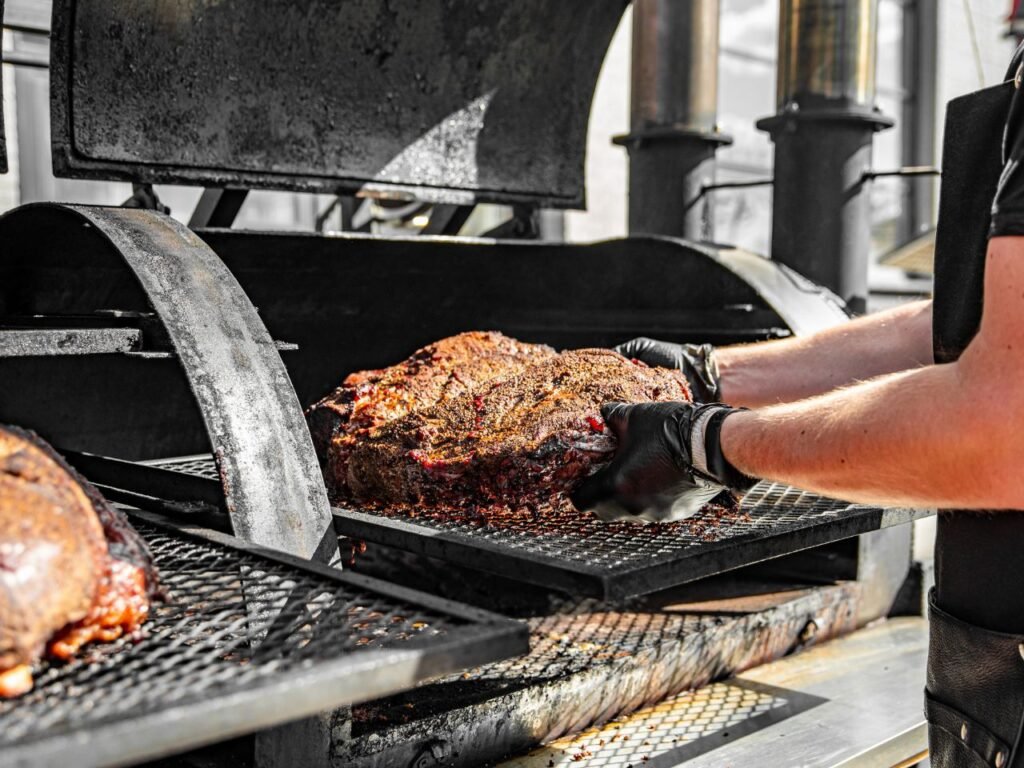
At a base level, smokers work by funneling smoke and heat into your food for long periods, creating a unique environment that forces flavor into whatever you are making in the large (usually cylindrical) chamber that houses the food. The fire that cooks the food is fueled by anything from wood, most commonly, to various kinds of charcoal with imbued smoke aromas to simulate the same scent and flavor. With a more controlled burn, it can even be powered by electricity, but that is more of a home situation than camping, and still entirely valid.
Advantages of Smokers
The primary advantage a smoker has over cooking over a campfire is the freedom to do as you please for a long time before checking on the food. Secondly, knowing that the food will have a very delightful smoky flavor and taste, backed by an exquisite tenderness to just about any meat you place in it, anything from a brisket to things that are simpler, like sausages, can be made into a unique flavor experience when cooked in a smoker.
If you wanted to utilize a smoker to its maximum potential, you’d like to strategically plan to bring one on your camping trip, and set your meal up to cook at the start of the day, having people from your group, or yourself, check on it a few times throughout the day, while getting full reign over all your activities knowing dinner is going to be phenomenal. It is worth noting that most meals do need to be smoked for upwards of five hours or more, so having small pre-made meals or extreme self-control to hold you over is pivotal.
Disadvantages of Smokers
Cooking with a smoker is a very detail-oriented set-up, meaning a lot of planning and preparation go into using one. Never mind hauling it to wherever you plan to camp or cook. Some people just can’t be bothered to do that, or have physical limitations preventing them from doing so, making smokers less than ideal in these situations.
Another point of reference is that some people truly dislike the smoky flavors they produce, in which case you’d definitely be dissuaded from using one in the first place. While not exactly a popular opinion, it is definitely one that exists.
Differences in Cooking Times
Cooking times matter greatly for people to different degrees. If you are impatient, then you’ll obviously want the faster cooking method; if you’ve got time to spare. It truthfully isn’t a big deal, and can allow you to focus on making side dishes or more, a campfire is traditionally thought of as a much faster cooking experience than a smoker, purely due to raw exposure to fire cooking (or burning if your timing is off) faster, whilst a smokers entire gig is that it takes a significant amount of time to make quality food.
Factors That Influence Cooking Times
Starting with the camp fire, the larger the flame, the hotter it technically can be, this coupled with the direct placement of your food can essentially change how fast it cooks, for example, if you thrust a hotdog into the center of a fire, it would be “cooked” in just a few seconds depending on how charred you like your hot dogs, but if you were to elevate that same meat over the fire, the time it takes to cook varies considerably with how far away from the flame it actually is.
A smoker can have its cooking times adjusted by varying the heat intensity. Still, in most cases, you are shooting more towards the flavor and not caring so much about how long it takes the food itself to cook, but again, it can be manipulated to some degree.
Type of Food Being Cooked
In the case of both campfires and smokers, you will definitely see that some foods can easily overlap and be cooked in similar ways, like hot dogs, sausages, and steaks. These can all be cooked similarly, with time as the main factor. However, specific cuts of meat don’t cook very well over a fire, like a brisket, for example, meaning you can technically make something that allows you to cook a brisket over a fire. Still, it would require some ingenuity to set up, but overall, you’d be putting in much more effort for a lesser experience.
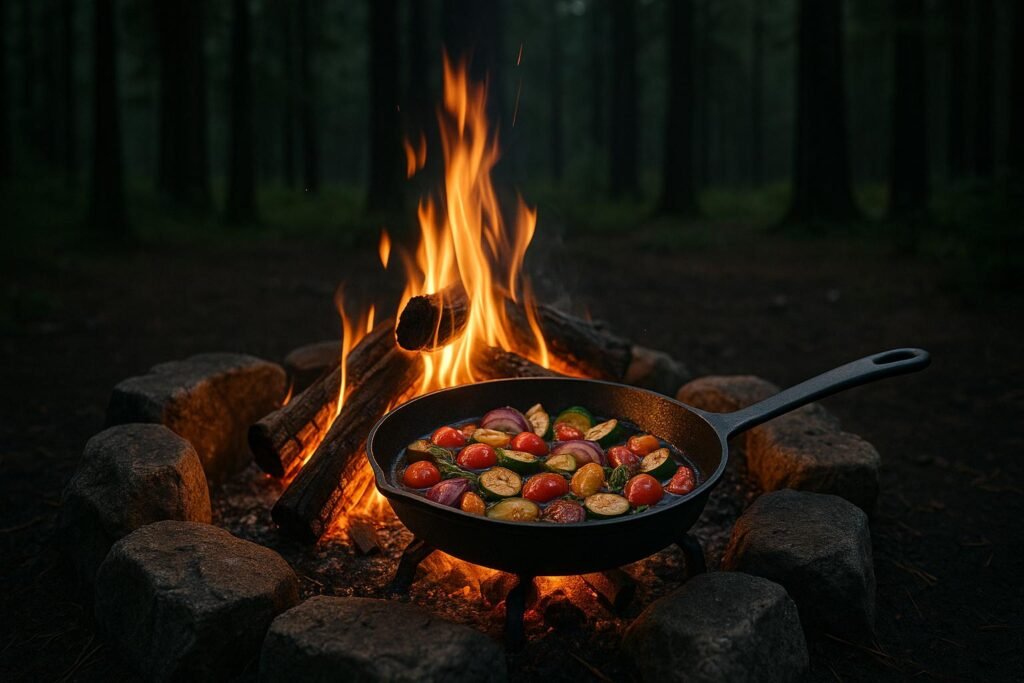
Campfires can also have their roses, so to speak, too; however, as with specific grating set-ups, you’d be able to use pots and pans, allowing you to cook beans, veggies, or soups over them, which can technically be done in a smoker, but it obviously isn’t its forte. You might end up damaging your cooking utensils and more for the effort.
Can Cooking Times Be Reduced Using Specific Tools and Accessories?
Absolutely, some techniques and tools can be sampled into either campfire or smokers that will definitely expedite the cooking process, for one, smaller cuts of meat like chicken for example can cook faster and more evenly in a smoker due to the more controlled heating, you could additionally sample in a water pan to add moisture to the smoker itself, making it even faster!
Noting what was said above, wrapping food in foil can allow you to place it closer to the flame or to rest it directly in it without the risk of burning, obviously making everything quicker. There is a litany of tools to be taken advantage of. Still, these are usually a pro and con situation, as speeding up the process usually impacts the taste at the end of the day, so a bit of trial and error is required to find that happy medium for each person’s unique cooking style.
Are There Common Mistakes That Can Increase Cooking Times?
One of the most basic mistakes someone can make that increases cooking time is not knowing how to use their equipment correctly or how to start a fire. This might seem incredibly basic, but nothing stomps out a fire (pun intended) like being unable to cook in the first place.
Pushing past the most basic issue, poorly prepping your food, not knowing where specific utensils you expected to utilize are, or using the wrong wood, charcoal, or heating method in general, can dramatically increase the time it takes to cook something. That is, before we consider cooking something “wrong” entering the arena, meaning you’d need to start over entirely, which significantly increases cooking time, or ends it entirely, depending.
How Does the Heat Distribution in a Campfire Compare to a Smoker?
The simplest breakdown of the comparison is night and day. A campfire is an unruly fire, often with significant heat variations all over the place, and that is before you factor in things like wind, airflow, and the occasional prominent hot or cold spot. This means you’ll have a much harder time controlling how your food cooks over a campfire just innately.
A smoker is literally all about control, down to the type of wood, pellets, or charcoal you use to feed the fire, as well as water pans that control moisture and other temperature-control features that may or may not be present in the smoker you purchase. Overall, smokers are for control; campfire cooking is usually for speed, whereas smokers feature extremely controlled heat distribution, whilst a campfire is all over the place.
Are There Any Specific Types of Foods That Are Best Suited for One or the Other?
Absolutely, briskets, for example, are almost synonymous with smokers. At the same time, a campfire can almost always be envisioned with someone roasting a marshmallow over a stick or a hot dog. Still, in much the same way you’d find it incredibly difficult to roast a marshmallow in a smoker, you can’t easily cook a brisket over a fire either.
What Safety Considerations Should You Know Before Cooking in a Campfire or Smoker?
When it comes to cooking over a campfire, you should be much more wary of the fire’s surroundings, who has access to it, and what options you have for dealing with the fire at a moment’s notice. If a strong wind blows, you could have sparks raining down over tents or gusting up into trees, creating a hazardous situation.
Alternatively, where you place your smoker matters just as much as you knowing how to properly ignite it, let alone use it, putting your smoker in a poorly ventilated area can very aptly have the area become “Smoked out” meaning there is no breathable air, creating a hazardous situation if you are confined to it, or annoying if people can freely come and go as they please.
Can a Campfire Be Used for Slow and Low-Temperature Cooking Like a Smoker?
Yes, with the proper set up and tools you can use a campfire to simmer things, over a low fire and a significant height from it, you can slowly cook something to some degree, the issue is more so that you don’t have a huge amount of control over how low you keep the fire, without constantly needing to check on it, and maintain that same level of heat.
In certain cultures, there are several methods that involve digging up campfire areas and using the heat of the ground itself to continuously cook food for longer periods. Still, extensive research, planning, and prep work are required to do this successfully without damaging your food or creating a safety issue.
Difference in Cooking for a Campfire and a Smoker
A campfire is more about the experience and utility it provides than solely as a cooking option. In contrast, a smoker is almost entirely dedicated to making savory food that doesn’t need to be checked constantly, allowing you to make an eventful day around having some flavorful food at the end, rather than continually checking and watching your food throughout the day.
Conclusion
Ultimately, there is a very unique sweet spot where you can make some elaborate and delicious food over a campfire. You can definitely set up some low-effort, slow cooking options using one, or the remnants of it. Still, ideally, a campfire is meant to provide heat and an option for cooking, where the smoker is not only going to give you the luxury of a delightfully cooked meal, but you can hang out with your family, enjoy the scenery, and set the expectation of being more in the moment, and less in the proverbial kitchen.