
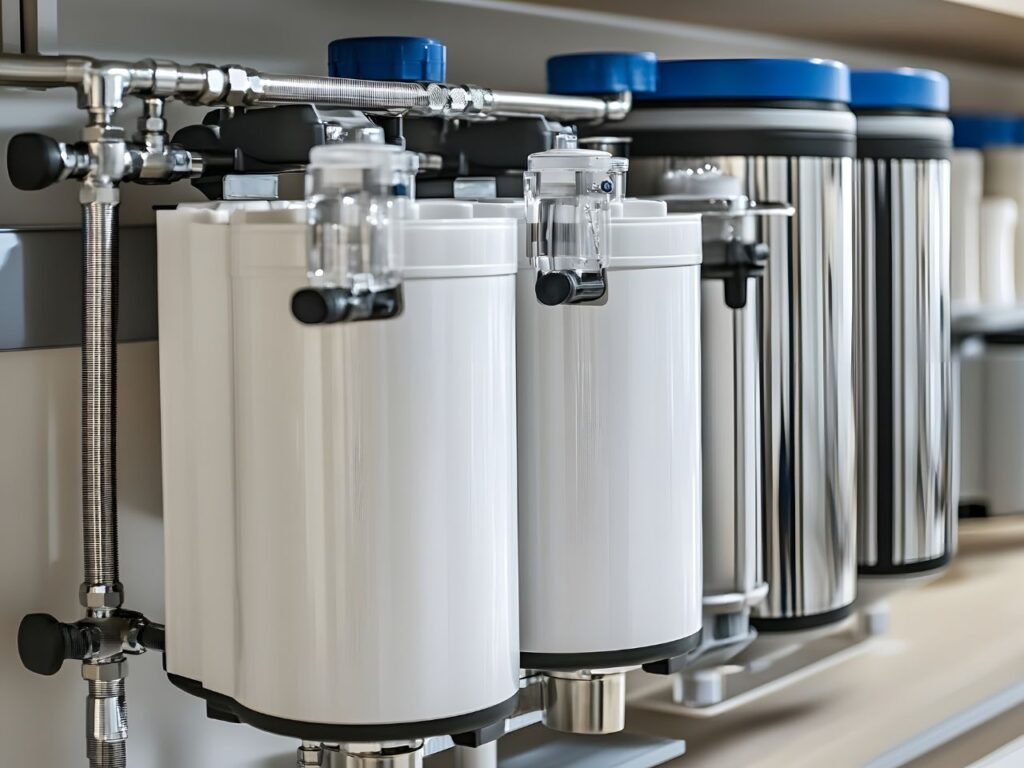
For those who have an RV and travel a lot, you know exactly what it is like to go from one place to the next and have the water taste completely different. Because of this, you would need a water filter that you and your family or friends can trust. In that case, you might find yourself wondering, Is the best RV water filter system?
The best RV water filtration systems are those that technically fill a few basic needs. For one, they shouldn’t inherently dampen the flow of your water—slowing it down a bit, sure, but completely gutting it to a snail’s pace isn’t acceptable.
The filters should not only last long enough for the initial investment to matter, but also be relatively affordable, even if they serve an essential need. Most of all, an RV filter should do its job—filter contaminants and undesirable particles from your water.
Below are five excellent water filter systems that will work well in your RV. Those new to RV life might also wonder why it is essential to have a good water filter, which we will discuss further below. We encourage you to continue reading on for more information!
Why Is It Important to Have a Good Water Filter for Your RV?
Well, the concept of drinking dirty water—much less water that has microbes and other things that can make you incredibly sick—doesn’t sound appealing to most people. So, having a water filter is almost common sense, even though many people still drink tap water at home.
Having access to clean drinking water, or at the very least water you can boil to achieve proper sterilization and then use, is akin to giving yourself the ability to keep living. Not every location you camp at provides water or has easy access to any. We can usually go only three days without water before we begin to suffer and enter dangerous territory (pun fully intended), so it is essential to ensure you have water.
Even if we were to take water consumption out of the equation, clean water has a litany of other uses beyond drinking it directly. You can clean with it, water a makeshift garden, or even clean wounds. Cleaning a wound out with dirty water is probably a worse idea than not cleaning it at all. Still, the point remains, there are plenty of reasons to have a solid water filter on your RV.
What Are the Best RV Water Filter Systems?
As we’ve noted before, the best water systems are affordable, efficient, and do not take up a ton of space. They also do not impact the flow of your water to the point of becoming a drip-based system. Further, there are specific certifications these filters can obtain to ensure you won’t be poisoned when exposed to the materials they are composed of, or, more importantly, that the filters actually work in the first place.
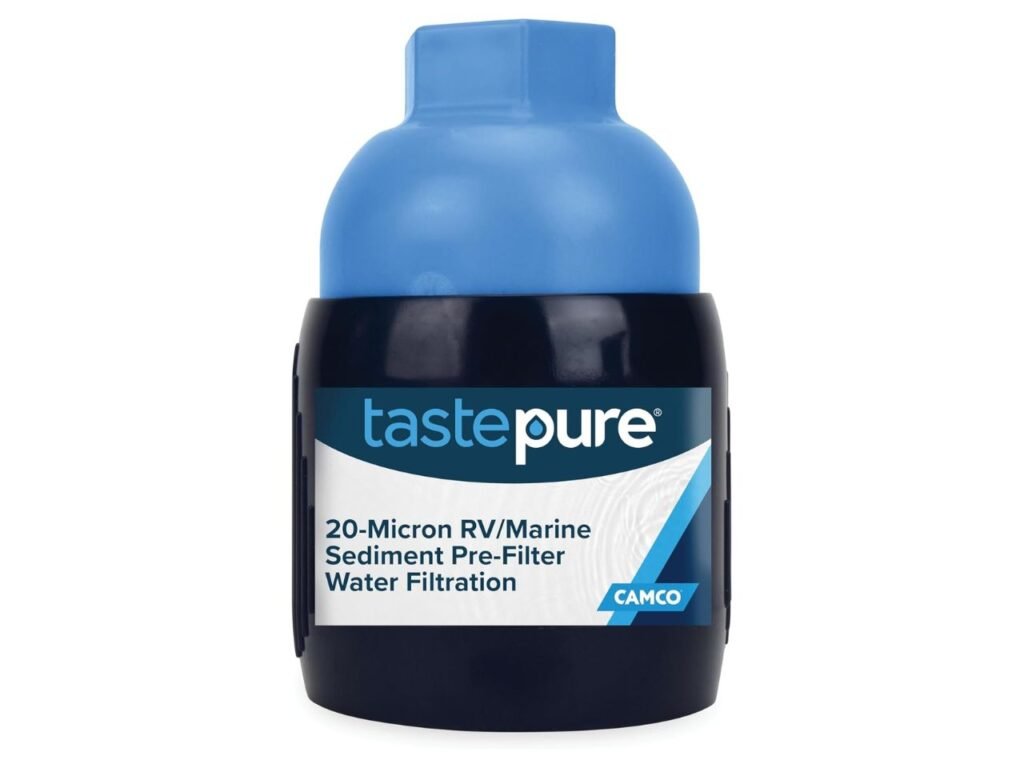
1. Camco Tastepure Sediment Pre-Filter for RV Water Filter
Camco’s water filter meets several of the qualifications above we discussed earlier, most notably hitting the affordability metric on the head, costing just under ten dollars (as of writing this article, mind you). You can’t beat that price for a compact filter that offers 20-Micron filtration, is certified lead-free, and meets NSF certification requirements to boot.
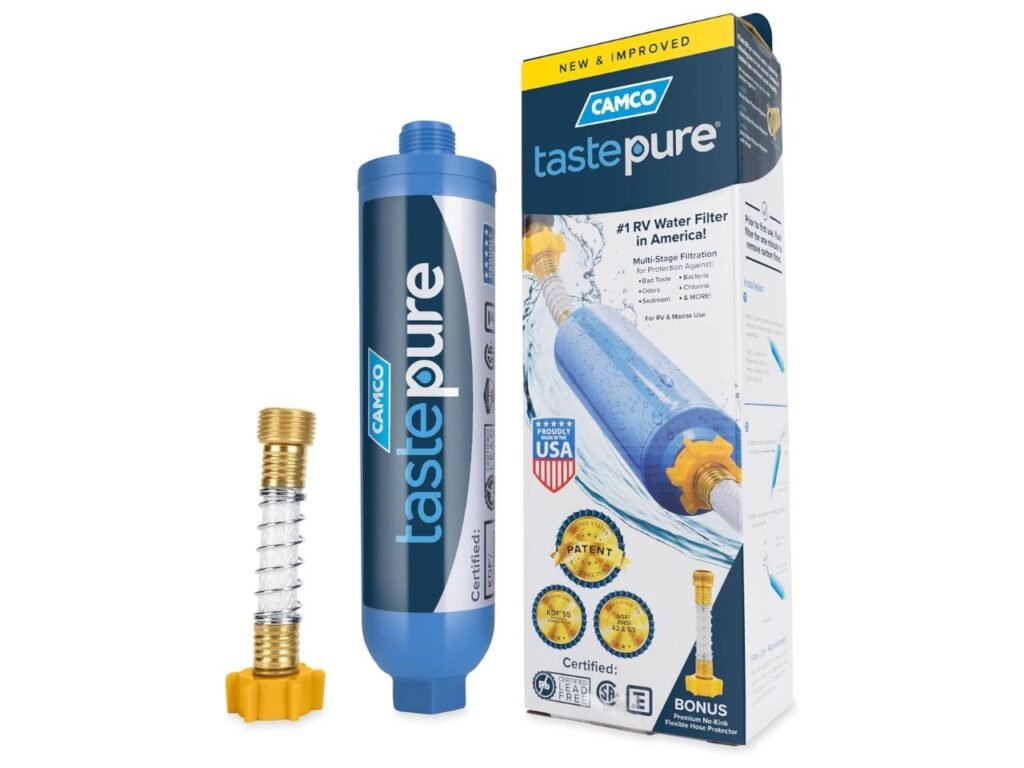
2. Camco Tastepure RV Water Filter
Having filtered water in your RV is just one facet of enjoying your water without worrying about how it may affect you in the long term. Camco’s second entry in this list features the same brilliant filtering technology as its normalized filter, but this time it comes with an adapter that fits comfortably on a hose.
All this to say, this has the makings of turning outdoor use into a much safer, and controlled experience, letting you use your hose as you see fit, with all the benefits of an NSF certified filter at your disposal, even more impressively, it reduces any awkward tastes that might remain in the water itself, and obviously removed bacteria and other impurities as intended.
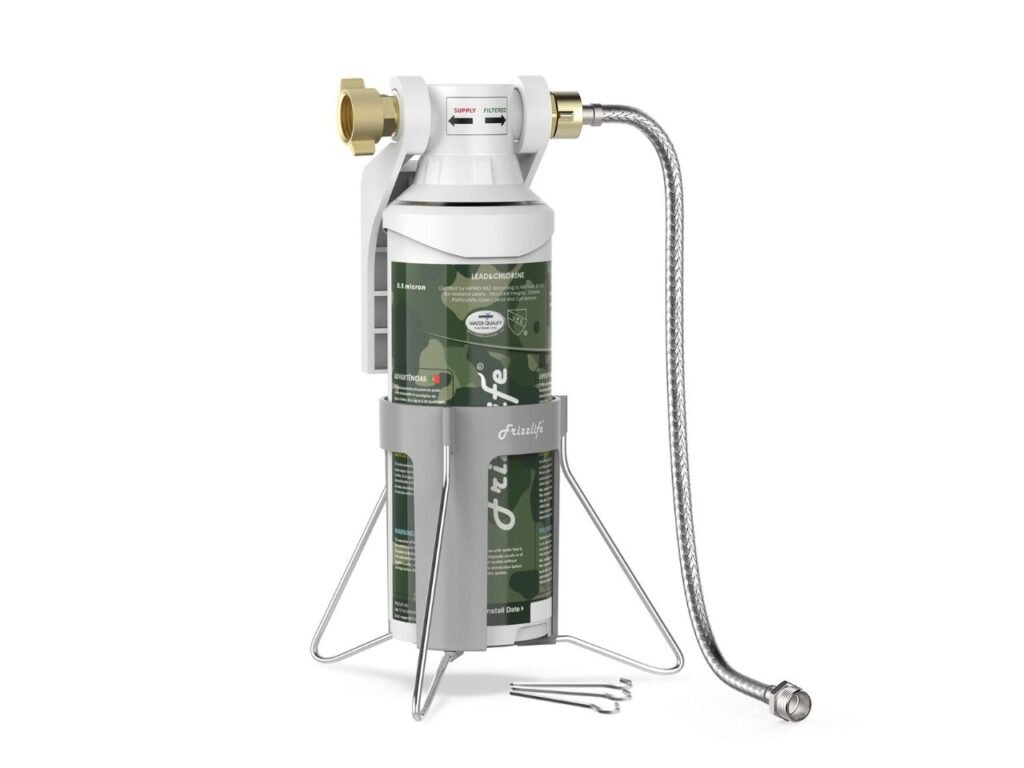
3. FRIZZLIFE RV Water Filter
It’s nice when affordability and product versatility meet on an eye-to-eye level. Frizzlife turns water hose use into an art form, removing every trace of dirt, bacteria, and unwanted smells from your water. Made with an incredibly durable design, brass connections, an auto-shut-off feature, and an incredibly easy installation process, you can’t go wrong with this RV water filter.
While this particular filter might be on the pricier side of things, you can rest assured that for that price, you won’t be enjoying any particles floating in your water, best of all the filter itself can be set up and used within just five minutes of getting it, while some filters might have you struggling with set up times for even half the filtration power.
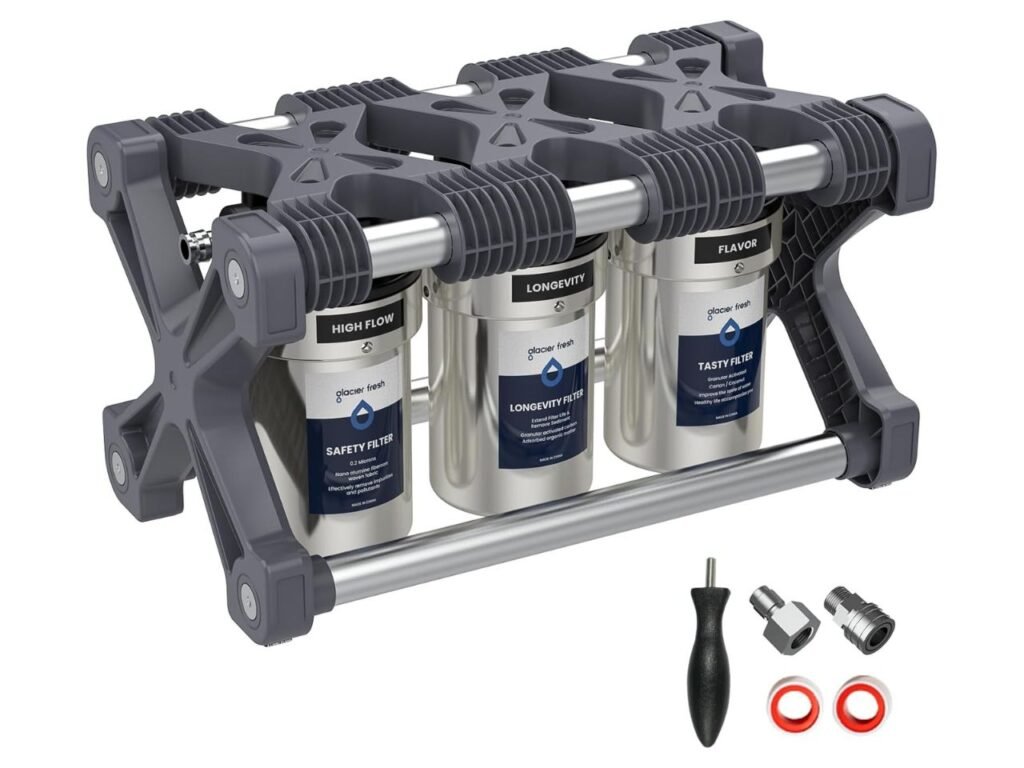
4. GLACIER FRESH Replacement for Technology RV Water Filtration System
Designed specifically for RVs, the Glacier Fresh filtration system takes itself—and your water purity—seriously, featuring a three-stage filtration system that focuses on flow, water purity regulation, and, finally, overall flavor. Your water will taste crisp, just as the filter’s name suggests.
Despite this filter being one of the most expensive ones on this list, you get precisely what you pay for. Thankfully, this filter is no exception, featuring powerful stainless steel connections, a lightweight design, and, finally, a filter replacement system that won’t financially destroy you on upkeep.
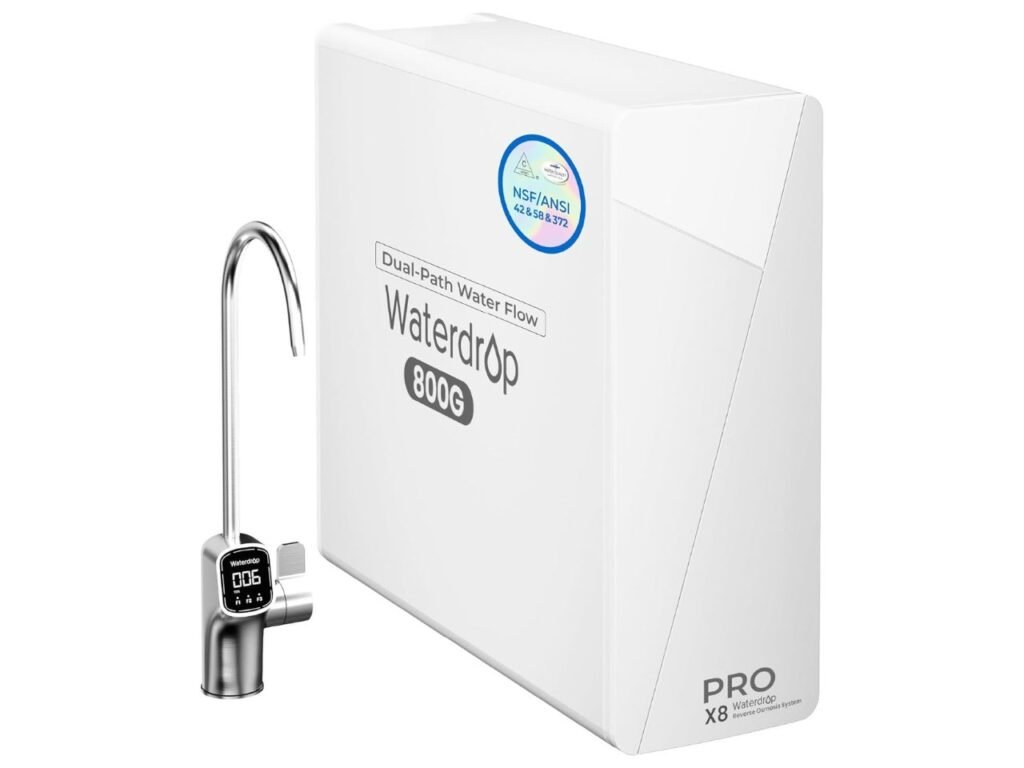
5. Waterdrop X8-PRO Reverse Osmosis Water Filter
Drinkable water isn’t something to be taken lightly, and Waterdrop knows that, and showcases it brilliantly with the X8-PRO, featuring a very unique nine-stage filtration system. You can trust that every drop you get is as safe to drink as you can get, altogether forgoing anything but purity, even price.
Such a powerful filtration system will cost you a pretty penny. Still, it’s true that when you get such a powerful, durable product, with a compact design, a sleek look, and the ability to use the system for two whole years before needing to replace any filters, it has an almost fire-and-forget usage, making the entire system even more valuable.
The one caveat to this entire filtration would be that it probably requires a bit more effort to install than other filters, needing to be installed directly to a faucet for one, and requiring a few holes to be drilled into the countertop or installation to be securely installed; otherwise, you can’t go wrong with this bit of beauty.
What Should You Look for in an RV Water Filter System?
The best water filtration systems don’t limit the amount of water that can actively flow throughout your RV, and they also have a respectable lifespan for those filters, because no one wants to replace filters weekly or worry about them functioning correctly.
1. Good Flow
Having constant access to purified water is something most of us take for granted now, but few and far between are the times that we think about what filtered water used to mean, needing to run through a lengthy process, and often drip slowly into a collected pool to enjoy the benefits of having pure water.
Modern technology has expedited this entire process, but we should still be mindful that the rate of water we have access to shouldn’t have us settling for less. A good filter does its job quickly and efficiently, meaning a full cup of filtered water should be readily available in a few seconds, not a few minutes.
Any system that interrupts your flow will inadvertently interrupt your day, leaving you with less time for the things that are important to you or requiring you to build your day around acquiring water —a problem that was much more relevant in times of old.
2. Filter Lifespan and Cost
Some filters aren’t designed to be easy to replace or affordable, making you rotate monthly with almost no regard for how much each replacement costs. At the same time, clean drinking water is a priceless resource, money doesn’t grow on trees, and the time spent replacing filters is valuable in and of itself.
A good water filter shouldn’t have you replacing it more frequently than every 4 months per usage period; anything less, and you are significantly cutting into your own time and wallet, with very little to show on the front end, especially if your water isn’t absolutely peerless to competitors in the filtration game.
3. Contamination Removal
It’s almost an afterthought, but the entire point of a water filtration system is to do just that: filter your water of contaminants and ensure it’s both drinkable and usable daily.
Some filters are designed to go above and beyond normalized usage, eliminating almost all contaminants, or to have filtration systems so precise that you might be tasting water purity on a scale you haven’t experienced even in your own home.
Regardless of the circumstances, the bare concept is that the filtration system should work and do so efficiently enough to prevent you from getting sick, drinking it, or damaging your skin when used recreationally.
4. Flow Rate
Flow rate usually refers to how much filtered water you can access, rather than how fast unfiltered water flows. In most cases, the water itself loses some of its pressure when going through a filter, slowing down how much of it you have access to. Still, it shouldn’t turn into a situation where filling a cup of water takes twice as long when utilizing your filter, for instance.
5. NSF Certification
At its core, an NSF certification is proof that a product meets safety standards, won’t break during routine use, and measures up to leading products in its line.
In the arena of water filtration systems, an NSF certification will lean towards water purity, how long your filters last, how durable the filter itself is, and finally, if the filter is made out of materials that are safe to interact with, both to the touch and when water has passed through it.
6. Micron Rating
A micron is the raw measurement of an object or particle, typically measured at about one-millionth of a meter. A micron rating, however, is the measurable rating of how small a particle a filtration system can capture, preventing it from entering your filtered water.
Traditionally, the lower the number, the better the filtration level. For example, a water filter with a 1 micron rating is much better than a 10 micron filter, as it is designed to capture and retain much smaller particles, thus offering much cleaner water.
Final Thoughts
To find a water filtration system that works best for you, you’ll need to ask if it’s intended for connection to a hose, or directly to a faucet, next you’ll need to ask yourself what kind of a budget you have to go towards the system itself, and finally, what micron rating you want, in conjunction with how much water flow you’ll want to retain at the end of the day.